

Ray's hands stiffen up when the weather turns cold. Arthritis in both of them, and it never cost him much until it started costing us time. One Friday in January he spent the better part of a minute trying to get a clean riffle on a fresh Copag deck. Tom reached over and did it for him. Nobody said a word about it, which somehow made it worse. That night, after everybody went home, I went upstairs and ordered the KPAW automatic card shuffler.
I have hosted this game for about nine years. Six of us most Fridays, in my basement outside Toledo, a wood bar along one wall and the folding octagon top sitting on an old round kitchen table. Small stakes, plenty of arguing, no serious money in the room. I am not a gadget man. I spent thirty-some years as a machinist and I trust a thing about as far as I can take it apart. So when I say five months of Fridays is enough for me to have an opinion on the KPAW, that is five months of real use, not a week and a video.
The Quick Verdict
It shuffles one or two decks on a single press, every Friday, without drama. Quieter than I expected but not silent, and one deck at a time is still its sweet spot. If you host and somebody at the table has hands that hurt, this earns its place.
Amazon Check Today's Price →The machine that gave Ray his deal back
One press handles one or two decks, and it runs on the battery that comes in the box. It has sat next to my dealer's chair since January and I have not had a single Friday without it.
Amazon Check Today's Price on Amazon →How I've Used It
The KPAW lives on the shelf under the bar when we are not playing, and next to whoever is dealing during the game. That is the whole setup. You set the deck or decks in, press the button once, wait a few seconds, and pull them out. There is a manual mode as well, which I use when somebody wants only part of the deck mixed, or when we are down to three players and the deck has gotten sticky from a long night.
Five months, call it twenty-odd sessions. We go every other week in the summer because of walleye season on Lake Erie, so the count is not quite as high as a full year of Fridays would give you. Every one of those nights, the shuffler was the first thing on the table and the last thing off it.
It handles the Copag 1546 plastic cards I keep in rotation without complaint. Those are thicker than paper cards and they have a bit of slickness to them, and a hand shuffle with a worn deck gets sloppy after the fourth or fifth pass. The machine does not care. Same motion on pass one and pass forty, which is the real thing I was after. A tired dealer at eleven at night is not a fair dealer.
The first night I set it down, Tom asked what it was and then asked whether it would eat his cards. Fair question, given the history. We ran one deck through it four times in a row and squared the stack up, and by the end of the night nobody was commenting on it at all. That is the highest praise a piece of table equipment gets in my basement.
What the KPAW Actually Does
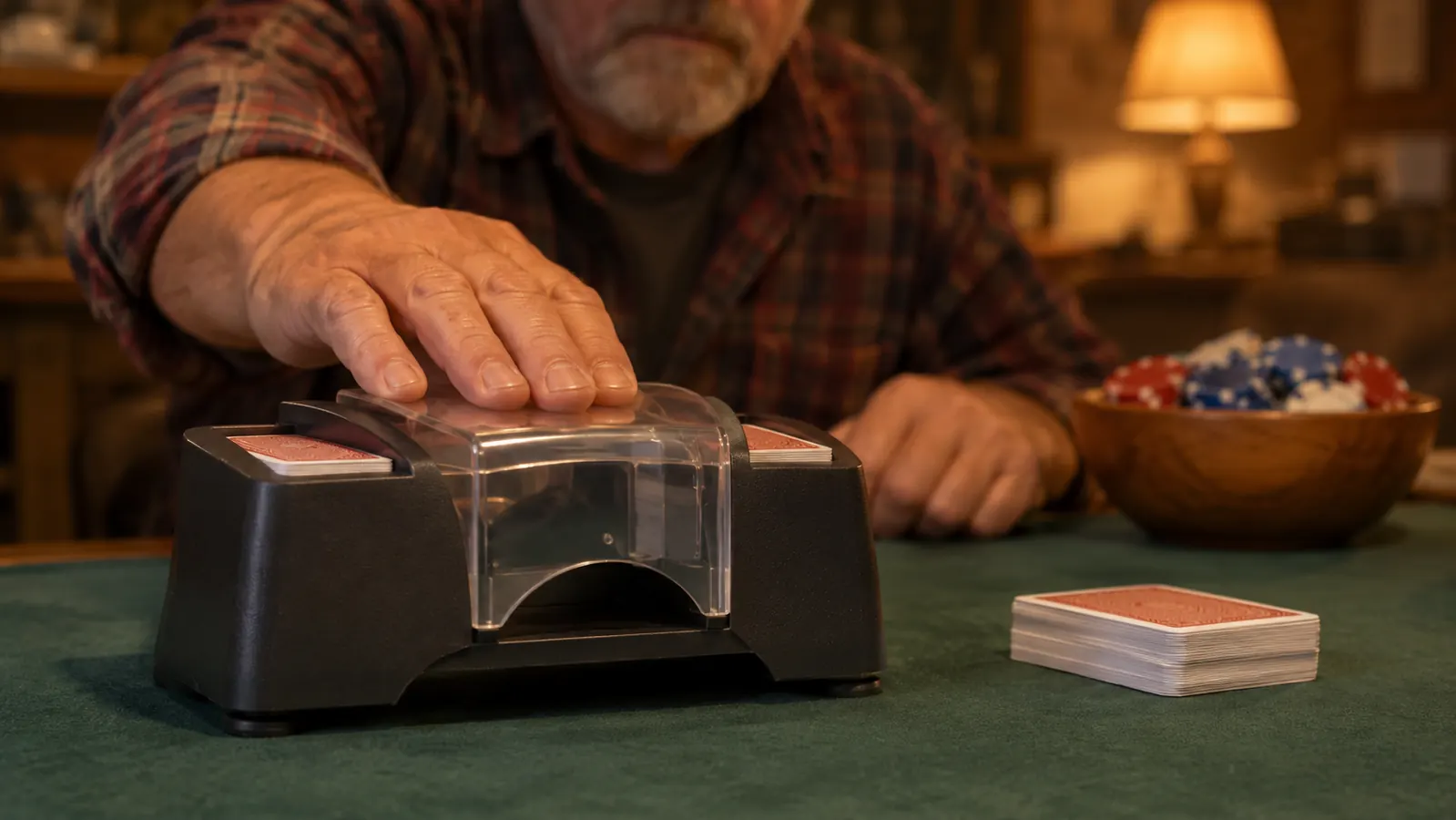
Strip away the listing language and here is the machine. It takes one or two decks at a time. There is a one-press automatic mode, which is what I use ninety percent of the time, and a manual mode for the nights you want to control the pass yourself. It runs on battery power, and the battery ships in the box, so there is nothing else to buy before the first game. It is listed at 11.2 ounces, light enough that Tom moved it from the bar to the table one night without noticing he had picked it up.
The low-noise claim is the one I tested hardest, because that is where cheap table gadgets usually fall apart. My basement is not big. If the shuffler sounds like a coffee grinder, six people have to stop talking every time the deck goes around, and after a while nobody uses it and it lives in a drawer. The KPAW is not silent. There is a mechanical hum and a soft clatter as the cards feed through. But we keep talking over it. That is the bar it had to clear, and it cleared it.
I timed it once, out of curiosity, with a stopwatch sitting on the bar. A single deck takes about ten seconds from press to ready, maybe twelve if the cards have been sitting cold in the case all week. Two decks run closer to twenty. That sounds like nothing, and it is, but it is ten seconds where nobody at the table is waiting on a person. The machine does the waiting instead, and the conversation never has to stop for it.
The two-deck capacity matters more than I thought it would. We play a lot of dealer's choice, and half the games in the rotation want a fresh deck shuffled in. Being able to drop both decks in, walk away, and come back to a mixed stack saves the little dead minute in the middle of a hand that used to be filled with somebody saying hold on, let me get these squared.
Manual mode is the feature I expected to ignore and did not. When we are down to a few players and playing something with a lot of discards, the deck gets sorted by accident. You end a hand and half the cards are still in near-suit order from the one before. Running the deck through in manual mode settles that without a full stop, and without me having to be the one who insists everybody wait while I shuffle.
How It Has Held Up Over Five Months
This is the part I care about most, and the part most reviews of anything are written too early to answer. Five months in, the KPAW still feeds cards the way it did in week one. No cracked housing, no button that has gone mushy, no change in the sound. I wipe it down with a dry cloth every few weeks and that is the entire maintenance routine.
It has jammed on me twice. Both times it was a two-deck run with the older Copag set, the one that has been washed with dish soap and has a slight curl at the corners. The machine pulled two cards at once and stopped. I lifted the stack out, squared it, put it back, pressed the button, and it finished the job. Two jams in five months, both with imperfect cards, is not a defect in my book. It is a machine being honest about what you fed it. If you keep your decks flat and clean, I doubt you see it at all.
One Friday in March we started at seven and did not quit until nearly midnight, which is late for this crowd. Six of us, dealer's choice, both decks in the rotation the whole way through. Call it forty shuffles by the end. The machine fed exactly the same at eleven forty-five as it had at seven oh five, and that is the whole argument for owning one of these instead of trusting the table's hands to hold up.
On power, the listing ships it with a battery and I have not had to think about it since it came out of the box. It sits for a week between games, gets used for four or five hours, and goes back on the shelf. It has not been a thing I have had to manage.
The bigger surprise is how the table took to it. I expected a certain amount of grumbling from guys who have been shuffling their own cards for forty years. What actually happened is that Ray started dealing more, because dealing is no longer the part that hurts. He used to hand the deck off after two rounds. Now he keeps it. That is worth more to me than the shuffle itself.
Ray used to hand the deck off after two rounds. Now he keeps it, because dealing is no longer the part that hurts.
The Two Things That Bug Me
First, it does not replace a cut. The KPAW mixes well, but I still cut the deck before the deal, same as I always have. If you are expecting to press a button and go straight into dealing, you will find yourself reaching for the cut out of habit anyway. Not a flaw exactly. Just do not expect it to be the whole ritual.
Second, it takes up table space in a room where table space is already tight. The folding octagon top seats eight and we run six, so we have room, but on the nights somebody brings a guest and we go seven, the shuffler is competing with elbows and cup holders. It is small enough to move back to the bar, and I do, but it is one more object in the middle of a game that already has chips, cards, and a bowl of pretzels in it.
What I Tried Before This
For eight and a half years the answer was hands. Mine, Ray's, Tom's, whoever was closest. That works fine, and I am not going to pretend a machine beats a good hand shuffle by much. A good hand shuffle from somebody who knows what they are doing is still the standard. The problem is that on a Friday night in a basement, by the ninth hand, nobody is doing a good hand shuffle. They are doing a fast one.
We also had a cheap battery shuffler somebody brought to the game years ago and left behind. It ate cards, it made a racket, and it went into a drawer and never came back out. That is the memory most of my regulars had of automatic shufflers before the KPAW showed up, and it is why I got a bit of a look when I set this one on the table. It took about three hands for that look to go away.
That old one had a plastic hopper that gripped the cards too hard and a motor with a whine you could hear from the stairs. It was a gift, and it was not built to last. It shuffled in the sense that the cards came out in a different order, and it also chewed a corner off the seven of hearts before it quit. I retired the deck and the machine in the same week and did not miss either one.
The other thing I considered was dealing off the top with a fresh setup every hand. That is fine for a tournament, but for a casual game with six friends it kills the rhythm. Too much ceremony between hands. The shuffler is quieter socially than a full stop-and-setup every time the button comes around.
One more thing on the hand shuffle. If you are good at it and you enjoy it, keep doing it. A machine is a convenience, not an upgrade in craft. What the KPAW buys you is consistency at eleven at night when nobody's fingers are at their best.
What I Liked
- Shuffles one or two decks on a single press, every time, with no hand strain
- Quieter than the cheap units my regulars remembered, quiet enough to talk over
- Runs on the battery that comes in the box, so it works out of the gate
- Light at 11.2 ounces and easy to move between the table and the shelf
- Gave the dealer with arthritis his deal back
Where It Falls Short
- Occasionally pulls two cards at once on an old, slightly curled deck
- You still need to cut after, so it is not a full replacement for the ritual
- Takes up table space on a crowded night
- Not silent, just quiet
Who This Is For
If you host a regular game and somebody at your table has hands that ache, this is close to a straight yes. That was my reason and it is still the best one. It is also for the host who is tired of the dead minute in the middle of every hand, and for anyone running two decks who wants them mixed properly between deals.
It fits a home game that plays a mix of games, because the two-deck capacity and the manual mode both get used in a dealer's choice rotation. It fits a table with older players. It fits anyone who has been handed a cheap shuffler at some point and wrote the whole category off, because this is a different class of machine.
I would also put it in front of anyone who hosts a game with a wide spread of ages. The shuffler is the one piece of equipment nobody at my table has an opinion about, and in a room where people argue about how the chips stack, that counts for something.
And it is for the host who has been doing all the dealing himself because he is the only one at the table who shuffles well. I did that for a long stretch, most of eight years. It is a strange kind of tired, being the shuffler at your own game all night. Handing that job to a machine nobody thinks about was a relief I noticed inside the first month.
Who Should Skip It
If you play once a month with a single deck and everybody at the table has good hands, you do not need this. A hand shuffle is free and it works. I would not talk you into it.
Skip it too if your decks are old and curling and you are not going to replace them. The KPAW wants flat cards, same as any feeder does. And if quiet matters to you above everything else, know that it hums. It is not a silent machine. It is a polite one.
Five months of Fridays, one shuffler, and a dealer who kept the deck
It takes one or two decks, runs on the battery in the box, and sits on my shelf under the bar between games. If your table has a Ray in it, this is the fix I found.
Amazon Check Today's Price on Amazon →