

Nine years of running a Friday night game in my basement, and the piece of gear I think about least is the chips. That is the compliment. You want the cards to be the thing people notice and the chips to be the thing that simply works, hand after hand, without anyone at the table having to think about them. When a set gets out of the way like that for three years running, it has done its job.
The Fat Cat 500-chip set has lived on the shelf behind my bar for about three years. I bought it to replace a 300-chip plastic set where the chips had started to fuse together in the case, so that pulling one off a stack brought three with it and part of somebody's bet went skating across the felt. Since then the Fat Cat has been out for every game night I have hosted: usually six of us, small stakes, the same core group of my brother-in-law Ray, my neighbor Tom, and three fellows from the shop I retired out of.
The Quick Verdict
The chips are the part that lasts. Three years of weekly play and not one cracked chip. The case and the buttons are ordinary, and you will notice them long before you notice the chips.
Amazon Check Today's Price →Three years of Fridays and not one cracked chip
500 Claytec chips at 11.5 grams each, dealer and blind buttons, two decks of cards, all in an aluminum case. This is the set I would buy again tomorrow.
Amazon Check Today's Price on Amazon →How I've Used It
I have owned this set about three years. For the last twelve months I have kept a small notebook in the bar drawer and written down what held up and what did not, which is the only reason I can hand you observations instead of impressions. Before that it was just use, no notes, no fuss. A set that survives a year of nobody paying attention to it is saying something too, and I would rather tell you both.
The game has not changed much in nine years. Six players most Fridays, seven when Tom's son is in town, stakes small enough that nobody loses sleep over them. We play dealer's choice for the first hour and settle into hold'em after that. Which means the chips get handled constantly for four or five hours: stacked, counted, knocked over, restacked, pushed across the table and pulled back.
The table is a folding octagon top that sits on an old round kitchen table, so the chips take a small drop now and then when somebody leans on an edge. My estimate is somewhere north of a hundred game nights on this set, which works out to a couple hundred thousand individual chips picked up and set down. That is a fair test of anything made of composite.
Friday starts around seven. I set the case on the bar, count the bank out into trays, and lay out the table top. People arrive, we argue about the music, and the first hand is dealt by eight. By eleven the case is back on the shelf. The set has been part of that routine for three years, and the routine is why I can tell you what it is like: I have done the same thing with it well over a hundred times.

What 500 Chips Covers at a Six-Handed Table
Five hundred sounds like a lot until you divide it, and then it sounds like exactly enough. I break the bank into ones, fives, tens, twenty-fives and hundreds. With six players at a starting stack, everyone gets a workable pile of the small chips plus enough of the big ones to build a bet without sliding a tower of ones into the middle of the table.
The set is rated for two to eight players and I have run eight exactly once, when Ray brought his son-in-law and a couple of others along. It worked, but I had to start everybody thinner on the low chips than I like, and we spent more of the night making change than I care to. If your game regularly runs eight or nine, buy more chips than this. If you run five to seven, which is what most basement games actually are, 500 is right and you will not spend the evening breaking bills out of the pot.
The one place the count pinches is the small denominations. Everybody wants fives, nobody wants a hundred, and with 500 chips and six players you have enough of everything as long as you deal the low chips out deliberately at the start instead of letting the table sort itself out. Do that and the night runs clean. Do not, and around hand thirty you are trading stacks across the table while the pot sits there waiting.
The case came with the dealer and blind buttons, and that matters more than people expect. Before I had real buttons I used a couple of coins and a beer coaster, and every single week somebody asked whose turn it was to deal. Now the button sits in front of the dealer, the blinds sit in front of the blinds, and the question does not get asked.
How the Chips Feel Three Years In
The weight is the thing. These are 11.5 grams each, and that number does more for the feel of a game than anything else on the box. A light plastic chip feels like a checkers piece. You pick it up and your hand knows it is not worth much. An 11.5 gram chip has enough mass that a stack of twenty has some heft, and when you set a bet down in front of you it lands with a small solid sound instead of a click.
They are Claytec, which is a composite, not true clay. I have handled real clay chips at a card room in Detroit and I will not tell you these are the same thing, because they are not. What I will tell you is that after three years the difference has not come up at my table one time. Nobody has ever picked one up and said it felt cheap.
The wear has been close to nothing. I have not retired a single chip for a crack, and I cannot say that about the plastic set this replaced, which had two split inside a year. Sorting them back into the case takes me about ten minutes on a Friday before people arrive, and I do most of it by feel as much as by eye. That tells you something about how uniform they still are.
The other thing worth mentioning is the sound. Composite chips do not ring like thin plastic and they do not clack the way some sets do. That is a small thing until you have played on a table that clacks for five hours, and then it is the only thing you hear.
What I cannot tell you is how these compare to a set from a card room supplier, because I have never owned one. I can tell you that nobody in my game has ever brought a set of their own and suggested we use it instead, and a couple of these fellows are particular about their gear.
Three years, more than a hundred game nights, and I have not retired a single chip for a crack.
The Case, the Buttons, and the Cards in the Box
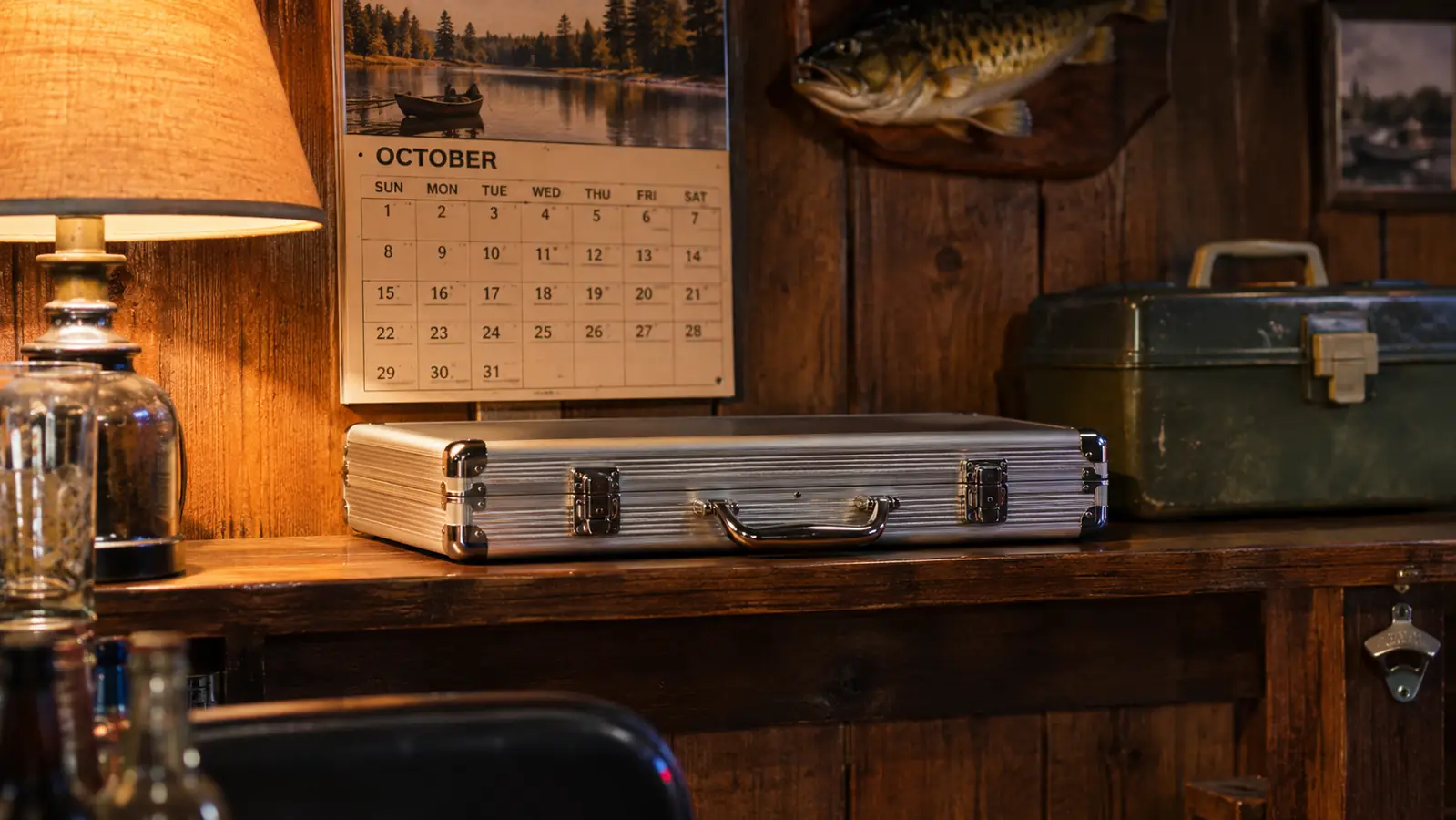
The case is aluminum and it is the part of this set I am least excited about. It does its job: the chips stay in it, it is light enough to move from the shelf to the table without a thought, and it has survived being stacked under other things down there. But an aluminum case at this level is a thin shell, not a piece of luggage. Mine has picked up a couple of small dents and a rattle over three years, and I expect it will pick up a few more.
The portability is worth a sentence. The maker lists this set as portable and travel sized, and that is accurate. It is a one-hand carry from the shelf to the table, and if you take your game to somebody else's house once a season, this is the right shape of thing to put in the trunk. It is not luggage and I would not check it on a plane, but for a car trip it is fine.
The buttons are basic plastic. They work, they are still readable, and the printing on the one I use most has gone a little soft at the edges. For a home game that is fine. If you run something bigger, a heavier button is an easy thing to buy separately.
I cannot tell you how the two included decks hold up, because ours went into a drawer in the first month. We had already moved to plastic cards, and once you have shuffled plastic a few times you do not go back. If you are starting from nothing, the decks in the case will get you through your first several games, and that is what they are there for.
What Wears Out First
Honest accounting: the chips are the strong part and everything around them is ordinary. Three years in, the Fat Cat case is the piece showing its age, not the chips inside it. The buttons will fade. The cards are a starter set. If I were buying again I would change nothing about the chips and everything about how they are stored, which is why the bank now lives in acrylic trays on the bar and the rest stays in the case on the shelf.
The warranty is 30 days against manufacturer defects. That is a short window and it tells you what the maker thinks the risk is. Three years in, I have never needed it. But if you open the case and find something wrong, you have about a month to say so, and you should say so the first week rather than at the end of the season.
One more note: the maker lists this set at 14 and up. That is about right. A full case of 500 chips is not a toy, and a kid who drops it on a foot will remember it.
What I Liked
- 500 chips at 11.5 grams each, enough for a six or seven handed game with room to spare
- Three years of weekly play and not one cracked or retired chip
- Includes dealer and blind buttons, which ends the weekly argument about who deals
- Aluminum case keeps the set together and moves easily from shelf to table
- Rated for two to eight players and built for a basement game, not a casino floor
Where It Falls Short
- The aluminum case will dent and rattle with age
- The buttons are thin plastic and the printing softens
- The included decks are a starter set at best
- Not enough small denomination chips if your game regularly runs eight or more
- 30-day warranty is a short window
Who This Is For
This is for the host who runs a weekly or twice-monthly game with five to seven friends and wants to stop thinking about chips. If you are upgrading from a plastic set that sticks together, the Fat Cat set is the upgrade that ends the search for a few years. It is also a sensible first real set for somebody who has been playing with whatever was in the closet and is tired of making change out of the pot.
And if you are the person who ends up hosting because you have the basement and the table, this set takes one more decision off your plate. You buy it once, you put it on a shelf, and you stop thinking about chips for several years. That is worth more than it sounds like when you are the one setting up every Friday.
Who Should Skip It
Skip it if your game regularly seats eight or more with deep starting stacks, because you want a thousand chips and not five hundred. Skip it if you are building a serious tournament setup and want a heavier chip and a proper hard case, because you will pay for those and you should. And skip it if you want the case to be the nice part of the package. On this set the case is the afterthought and the chips are the product.
And if you already own a set you like, there is no reason to change. This is not so much better than a decent composite set that it justifies starting over. It is a good set at a sensible size, not a revelation.
If your Friday game is still making change out of the pot, this fixes it
Five hundred Claytec chips at 11.5 grams, the dealer and blind buttons, two decks and an aluminum case. Mine has been on the shelf behind the bar for three years and it is staying there.
Amazon Check Today's Price on Amazon →