
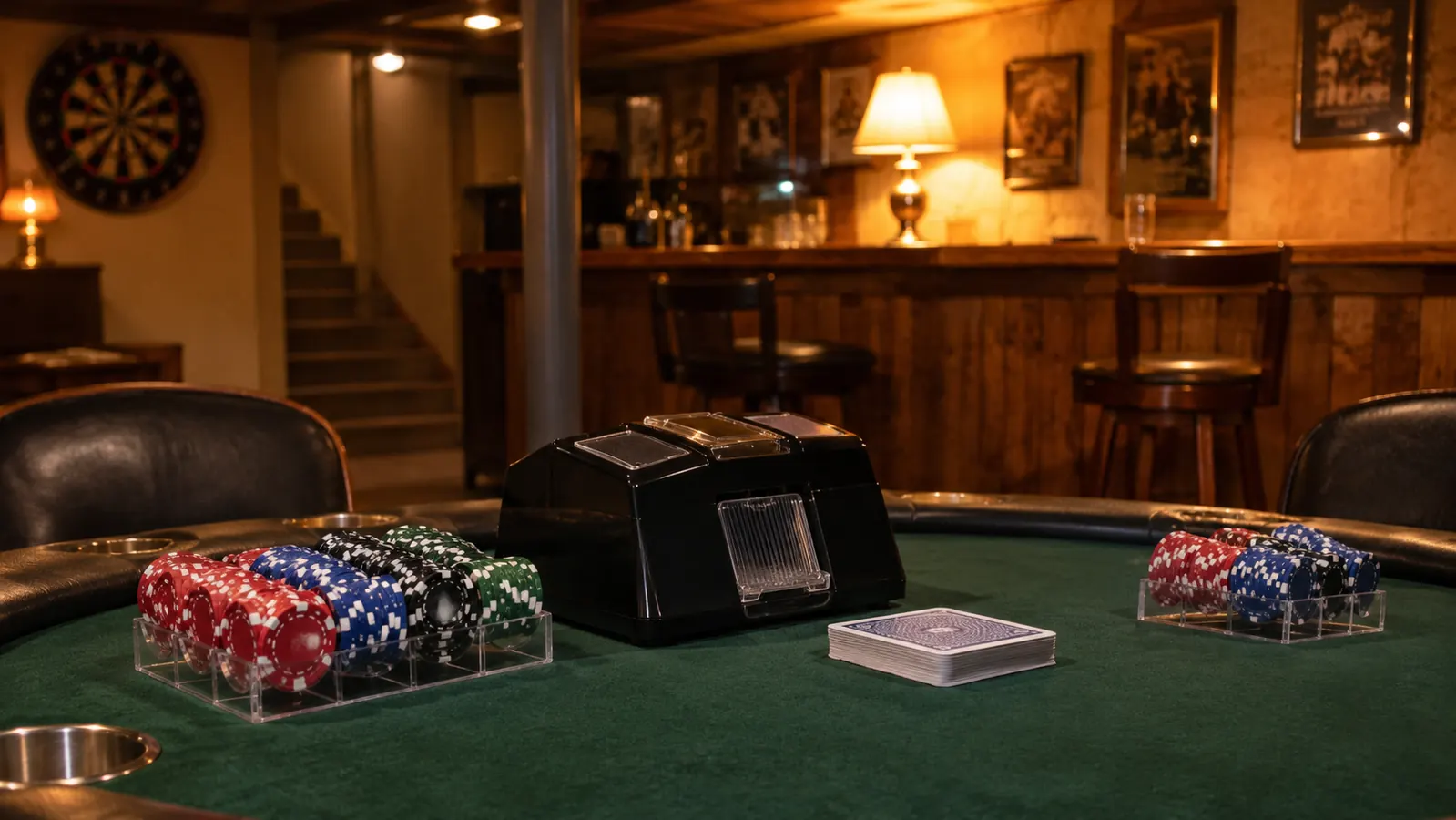
There is a moment about four hands into a Friday night game when everything stops. The deck gets passed to whoever is willing to shuffle, that person shuffles, somebody across the table says the shuffle was thin, and it gets shuffled a second time. Six players and forty or so hands means a good chunk of the evening goes to watching somebody's thumbs.
That is why I bought the KPAW automatic card shuffler about five months ago. Not because I like gadgets. My brother-in-law Ray has arthritis in both hands, and by nine o'clock he was sliding the deck toward his neighbor instead of shuffling it himself. The KPAW sits next to whoever is dealing now, and Ray deals all night without his hands quitting on him. What follows is what I found over five months of Friday games, including the parts the product page does not dwell on.
The Quick Verdict
Quiet enough that the table keeps talking over it, easy on older hands, and it will still jam if you feed it a bent card. Worth it for a weekly game, overkill for a family card night twice a year.
Amazon Check Today's Price →The fix for a table that spends half the night shuffling
Five months of Friday games, one thumb press, and Ray deals all night again. If shuffling is the slowest thing at your table, this is the piece that changes it.
Amazon See the KPAW Shuffler on Amazon →The Short Version, Before the Small Print
The machine itself is a small plastic unit, 11.2 ounces, light enough that I move it around the table without thinking about it. It takes one or two decks, it has a one-press auto mode, and it has a manual mode for when you want to control the pass yourself. The listing calls it low noise and rechargeable. It is portable in the sense that anything weighing eleven ounces is portable, and it lives in the cupboard behind my basement bar between games, next to the chip trays.
What it does not do is worth saying plainly. It does not sort, it does not deal, and it does not fix a deck that has been handled badly. It moves cards from one place to another and back again. Treat it as a machine that saves your hands and your table time, not as a dealer, and you will get along with it fine.
How It Has Actually Been Used
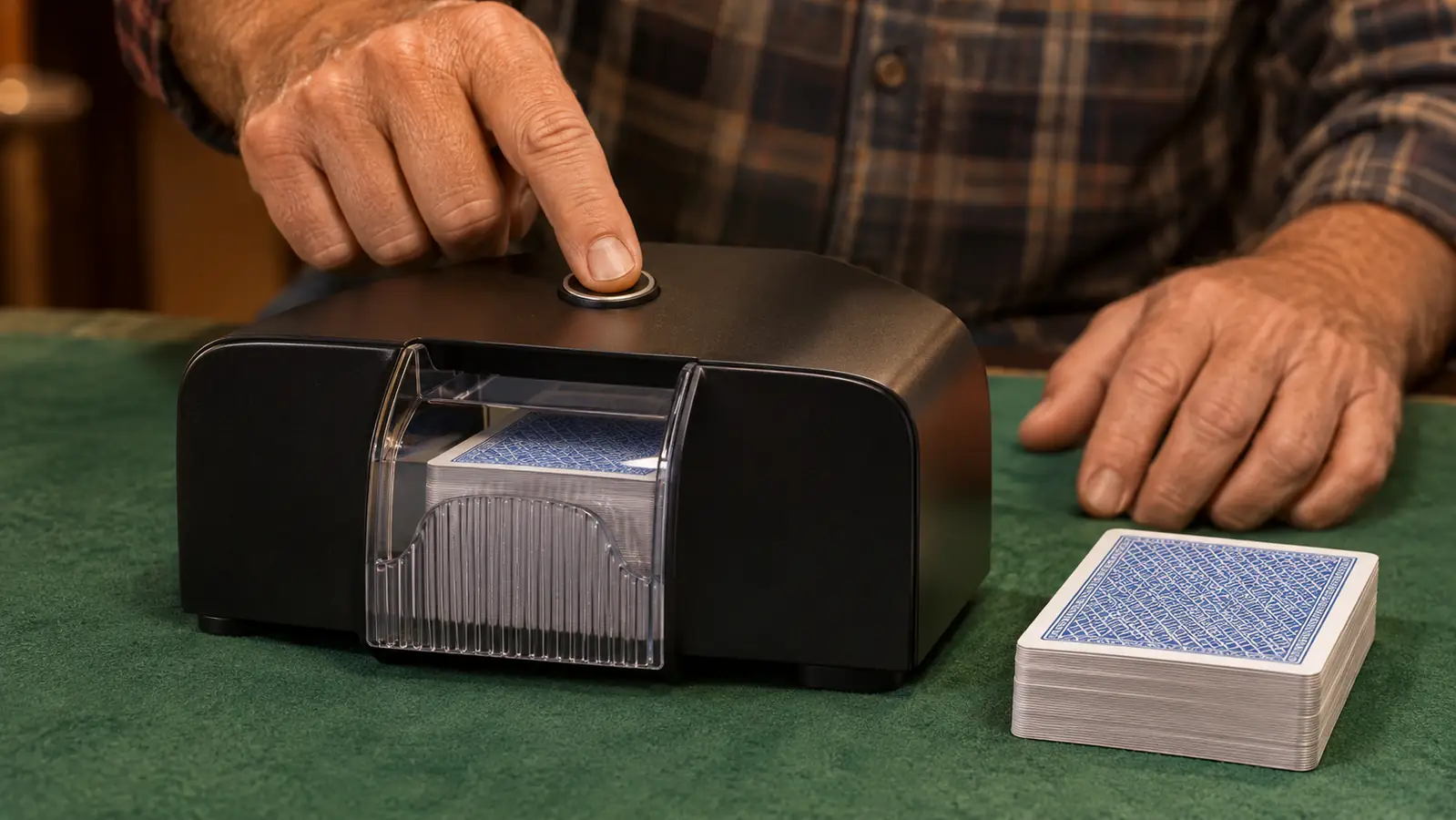
My table runs Copag 1546 plastic cards, red and blue double deck, jumbo index. I keep two sets in rotation, and the older of the two has been washed with dish soap more than once and is still dealing fine. The KPAW handles a single deck in a few seconds, five or six by my count, and a full two-deck setup in roughly twice that. That matches what the table needs, because we usually have one deck in play and one shuffled and waiting. The waiting deck is the whole point. Nobody at my table has to shuffle between hands anymore.
The one-press auto mode is what gets used nine times out of ten. You square the deck, set it in, press the top, and it feeds the cards through and stacks them back together. Ray does it with one thumb. Tom, my neighbor, was skeptical for about a month and now he reaches for it before I do. Between hands the machine sits about a foot to the left of whoever is dealing, close enough that they do not have to reach across the felt and out of the way of the chip stacks.
The second Friday in June we had a full table of six and Ray was dealing most of the night. I counted hands for the first hour out of plain curiosity, the way a retired machinist counts things. We got through eleven before the clock on the wall said nine. Two years ago, before the machine, that same hour would have been eight on a good night, and on a bad night seven. Nobody was playing faster or betting differently. The only thing that changed is that the ninety seconds of shuffling between every hand went away.
Where it earns its spot is that pace. We get through noticeably more hands in an evening than we did two years ago, and I do not think that is my imagination. The game feels less like waiting and more like playing. For a social Friday game with friends, that is the entire argument. It is not a machine that makes the poker better. It is a machine that makes the evening shorter on chores and longer on cards.
The manual mode is the one I use less, mostly when I want a specific number of passes on a fresh deck or when the stack going in looks slightly off and I would rather feed it myself, one pass at a time, watching each one. It is not complicated. It is the same machine doing one pass and stopping, and I let it run again when I am ready. Two passes on a brand new deck and it settles into the hand the way it should.
Charging has not been a chore. The listing says rechargeable and mine arrived with a battery in the box. I have topped it up a handful of times since spring, which is less often than I charge my phone and far less often than I used to run out for batteries for the old television remote down in the bar. There is no gauge on it that I have found, so I plug it in after a game night if the last few passes sounded sluggish. That routine has kept it from dying in the middle of a hand.
The Noise, Without the Marketing Language
Low noise is the claim, and I want to be fair to it and also honest. It is not silent. What you hear is a soft mechanical rattle, cards sliding and being pushed, somewhere around the volume of an electric can opener running in the next room. You can hold a conversation over it. It does not carry up the basement stairs, and Diane has never once mentioned hearing it from the kitchen.
I tested that on purpose one night in May, because I did not believe the listing. I left the basement, went up to the kitchen, and had Diane run a pass while I stood at the top of the stairs with the door open. I could hear it. It was faint, softer than the dehumidifier that runs down there all summer and nowhere near the old range hood upstairs. With the basement door shut I could not hear it at all over the television in the living room.
Two decks are louder than one, and a fresh stiff deck is louder than a deck that has been broken in. My Copags after two years are quiet. A brand new set out of the box has more snap to it for the first few passes. If you have ever shuffled plastic cards by hand at a quiet table, you know that sound. This is a different sound, but it sits in the same range, maybe a touch more noticeable because it is rhythmic.
Tom said it sounds like a small printer. That is about right. Nobody at my table has complained, and this is a group that will complain about anything, including the way I stack the chips. The one thing I would flag is the rhythm. A hand shuffle has a natural fade to it, and the machine keeps an even beat for the whole pass. If you are the sort who finds a ticking clock irritating, you will notice this. I stopped noticing it somewhere in the second month.
Four jams in five months, and every single one traced back to a card I should have thrown out two games earlier.
Jams, and What Actually Causes Them
It jams. I want to say that clearly because the reviews I read before buying did not. In five months I have had four jams. Every one of them came from a card that was bent, soft, or had something on it. The machine pulls cards through a feed, and a feed does not care about your feelings. A bent card catches, the next one piles up behind it, and the pass stops.
What causes it, in order of how often it happened to me: a deck that got sat on or bent in the case, a paper deck somebody brought over, and once a card with a sticky patch on the face that I did not notice. Plastic cards that stay flat and clean have not jammed on me once. That is worth repeating. The machine has never jammed on a good deck.
The worst one was in July. Tom brought a paper deck to the game because his grandson had given him a souvenir set and he wanted to show it off. The cards were soft and a couple had already started to curl at the corners from riding around in his jacket pocket. The machine got through about a dozen cards, stopped, and refused to move. It took me a couple of minutes to work the bent one loose without forcing anything. Nobody was angry about it, but the hand was held up and Tom felt bad about it, and I felt bad that he felt bad.
The one that annoyed me was the sticky card. Somebody had been eating something and the face had a patch on it you could not see in the lamp light. The KPAW took a pass, jammed halfway, and I stood there puzzled because the deck was plastic and plastic had never given me trouble. Once I found it, the fix took ten seconds and I wiped the card with a paper towel. Now I fan the deck across the felt before it goes in. It is a five second habit and it has saved me every jam since.
Clearing a jam is quick once you know what you are doing. I lift the card out, square the rest, and start again. Do not pull the stuck card from the side while the thing is running. I did that once and it made a sound I did not like. It kept working, but I do not push my luck with machinery. I spent thirty-five years around machine tools and I know what forced feed does to plastic.
The honest limitation is that it cannot tell you a card is bad. It will shuffle a bent card right up until the moment it will not, and then the game stops while you dig it out. If your group plays with paper decks, or with cards that live loose in a drawer, expect more of this than I have had. My four jams in five months come from a table that mostly feeds it good plastic. Your number could be higher.

How It Feels at the Table
The unit is light, and light has a tradeoff. It slides a little on felt when you press down on it, so I set it against the rail of my table top and it stays put. On a bare wood table it would want a mat under it. The plastic is plastic. It does not feel like something you hand down to your kid and it is not trying to. At 11.2 ounces it feels like a tool you keep in a cupboard, which is exactly what it is.
Five months in, mine has a couple of light scuffs on the outside from riding around in the cupboard with the chip trays. Nothing has cracked and nothing rattles that did not rattle the first week. I have not dropped it, and I would not want to, because eleven ounces of plastic landing on a basement floor is not a test I need to run. I treat it the way I treat the cards, which is to say I put it away dry and out of the way of elbows.
The feel of the cards after a pass is good. They come out squared and even, and the deck feels the way a deck should feel in the hand. A brand new deck wants two passes before it settles. My oldest set, the one that has been washed with dish soap and is still in play, goes through without complaint. That matters more to me than any number on a box. If the cards came out feeling shuffled by a machine, I would not use it.
What you give up is the shuffle itself. Some of the fellows at my table like shuffling. It is part of the ritual, the sound of it, the small pause while somebody works. Ray does not miss it. Tom does not miss it. I miss it a little, which is why the manual mode gets used more than the instructions would suggest. There is no wrong answer there, but you should know going in that a machine removes a small social ritual along with the labor.
What I Liked
- One press and the deck comes back squared, which Ray can do with a single thumb
- Quiet enough that the table talks over it, and it does not carry up the stairs
- Handles one deck or two, with a manual mode for when you want to feed it yourself
- 11.2 ounces, so it moves around the table and stores in a cupboard without fuss
- Noticeably more hands per hour at a six-player game
Where It Falls Short
- Jams on bent, soft, or sticky cards and gives you no warning that one is in the deck
- Slides on felt, so it needs to sit against the table rail or on a mat
- You lose the shuffle as a social ritual, and some players genuinely like it
- No gauge that I have found, so a low charge shows up as a slower pass instead of a warning
Who This Is For
This is for the host who runs a regular game, six or eight players, and finds that shuffling is the slowest thing at the table. It is for anyone whose hands stiffen up by the back half of the night. It is for a table where the cards are decent plastic and stay flat, and where somebody is willing to spend five seconds fanning a deck before it goes in. If that is you, the KPAW earns its spot next to the chip trays and you will stop thinking about it after the first month, which is the highest compliment I can pay a tool.
Who Should Skip It
Skip it if your group plays once a month with paper cards and condensation rings on the felt, because you will spend more time clearing jams than you save. Skip it if you like shuffling, or if the shuffle is part of how your table talks to each other. Skip it if you want something that deals, or if you expected it to sort a mixed deck back into suits. It does none of that. And skip it if a rhythmic mechanical rattle at a quiet table would bother you, because that rattle is what you buy along with the saved time.
Quiet, quick, and honest about the jams
Three things decide whether this works for you: plastic cards that stay flat, a game that runs most weeks, and a table that would rather play than shuffle. If that is your basement, it is worth a look.
Amazon Check the KPAW Shuffler on Amazon →