
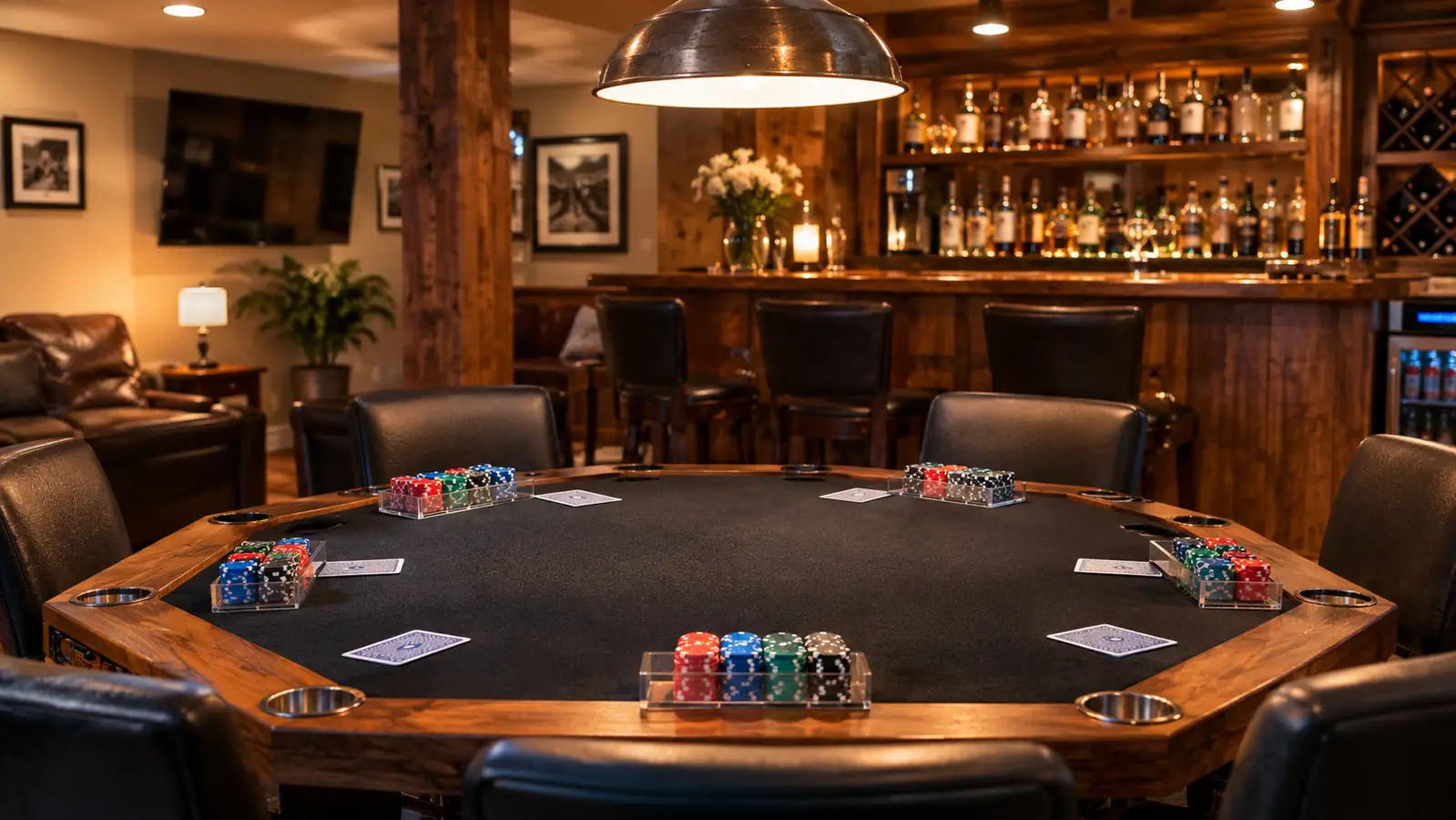
Every home game has two kinds of slowdown. One is the guy who wants to walk everybody through a hand he played in 2009. The other is the deal itself, and that one you can actually fix.
For years my Friday basement game shuffled by hand. Six of us around the octagon, one deck in play, one getting riffled behind it. It worked fine until it stopped working. My brother-in-law Ray's hands stiffen up with arthritis, and working a fresh Copag deck started taking him longer than the rest of the table needed to play the hand out. Five grown men sitting there, watching one man push two halves of a deck together. I bought the KPAW automatic card shuffler about five months ago for that one reason, and it did more for the pace of the night than anything else I have added to that room. Not because it is fancy. Because nobody waits anymore.
I am not going to tell you a machine makes anybody a better player. It does not. What it does is take the slowest forty seconds of every hand and turn it into nothing, and that changes the feel of a room. People stay in the conversation. The chips keep moving. The night has a rhythm instead of a series of pauses.
What follows is the five things I actually do, in order. Not a spec sheet. Just the moves that made the thing useful instead of a gadget on a shelf.
Nobody at your table should be waiting on the riffle
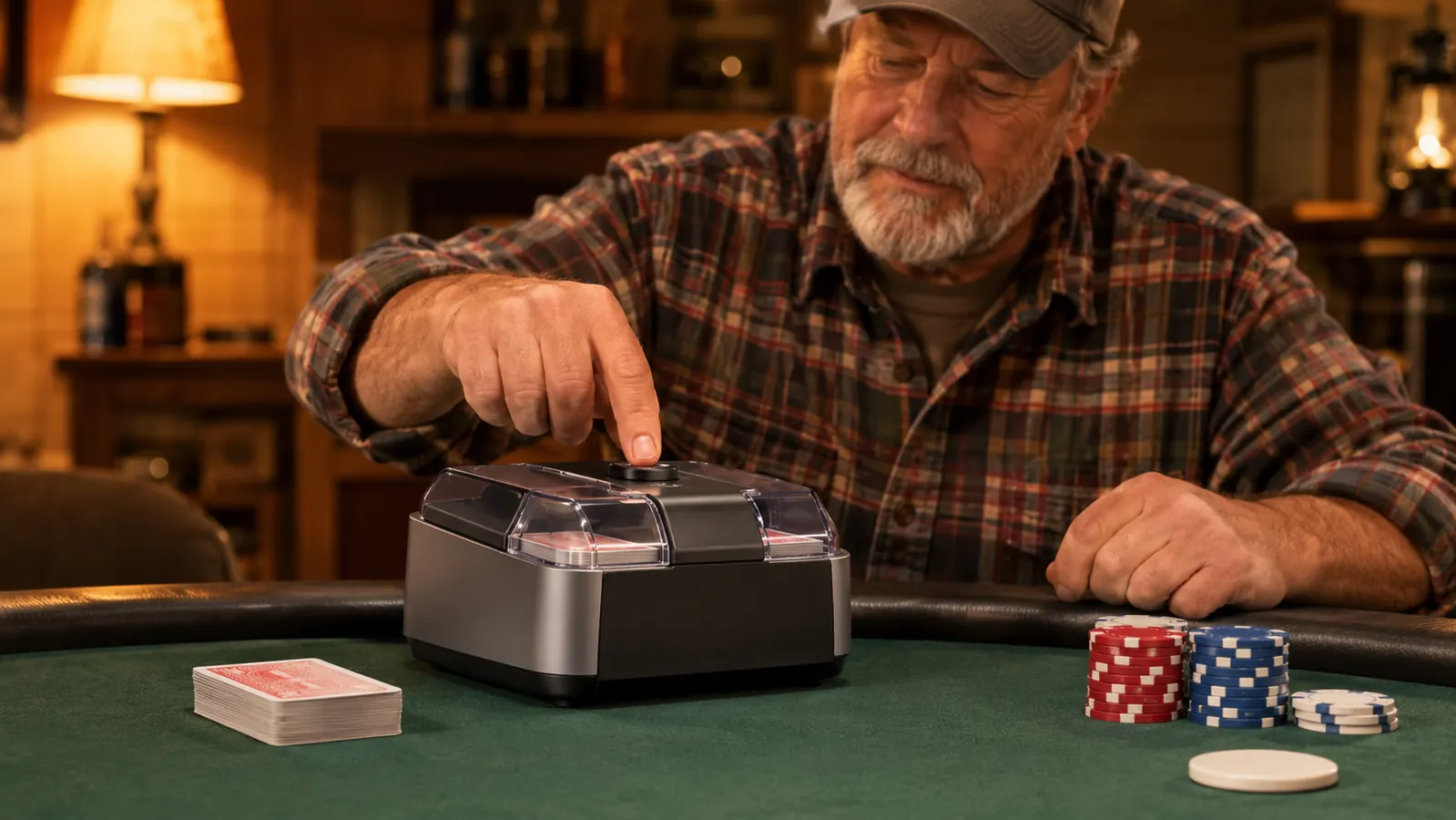
The KPAW runs one or two decks on a single press, and it is quiet enough that the hand in play does not stop while it cycles. That is the whole job. It does it.
Amazon Check Today's Price on Amazon →Step 1: Put It Where the Dealing Happens, Not Where It Looks Good
The first mistake is placement. A shuffler that lives on the far side of the table next to the chip bank is a shuffler nobody uses, because using it means reaching across two players and interrupting the hand. It has to sit within arm's reach of whoever is dealing, and it has to stay there all night.
On my setup that is the seat to the dealer's left. The machine sits right beside the deck in play, close enough that the dealer can drop a finished deck, reach over, and press once without standing up or asking anyone to move a glass. On the 48 inch folding octagon there is room for it. The unit weighs 11.2 ounces, so it claims about as much table as a coaster and a half and it does not crowd the cup holders or the chip stacks.
The other half of placement is noise. A machine that rattles is a machine people stop using halfway through the night, and I have played at tables where exactly that happened. The KPAW is engineered to run quieter than most, and in my basement it sits underneath the conversation. You hear it working. Nobody has to raise a voice over it. That matters more than raw speed, because a quiet machine can run while a hand is still being played, and a loud one makes everybody wait for it to finish.
Step 2: Know Your Deck Count Before You Press Anything
The machine handles one or two decks, and the difference matters more than it sounds. Most nights we run two. One deck is in play, being dealt and pitched into the muck, and the other is either already shuffled or about to be. That is the rhythm the machine fits into. One deck at a time, in and out.
What you do not want to do is treat it as a card dump. Two full decks jammed in because they were both sitting on the table is not what it is for. One deck, one cycle, take it out when it is done. If we are switching decks between orbits, the second one goes in after the first one comes out. That is the whole discipline and it takes about two seconds to learn.
Early on I did exactly the wrong thing. I had both double-deck sets out on the felt, four decks in two boxes, and I fed the machine two decks at once because they were already sitting there. It ran, but it ran slower and the mix was not as thorough as a single deck gets. Now the second set stays in its box under the table until the first one is done. Sounds fussy. It is not. It is the difference between a machine that works and a machine you end up blaming.
Card stock matters too. We play Copag 1546 plastic, jumbo index, two double-deck sets in rotation. Plastic cards are slick when they are new, slick enough that a hand shuffle sends half the deck onto the floor. The machine takes a fresh plastic deck without me having to break it in first, which is one of those small things I did not know I wanted until I had it. Paper decks work fine as well. They just do not last in a basement with a bar in it.
Five months of Fridays and Ray has not once handed the deck off to somebody else. That is the whole review, really.
Step 3: Use the One-Press Auto for the Routine, Save Manual for the Hands That Need It
The KPAW has a one-press auto mode and a manual mode, and after five months I use them for two different jobs. Auto is the workhorse. Deck comes out of play, deck goes in, one press, walk away and count your chips. It runs its cycle and stops. That is most of what the machine does at my table and it is the reason the night moves.
Manual is for the moments when I want to sit on the cycle myself. For us that is setting up at the start of the night, or when somebody new sits down and the deck has to be mixed harder than a single pass would do it. I keep it in manual, run it, and pull the deck when it looks right to me instead of letting one press decide.
The reason that matters is trust. Some players want to see a deck get mixed, especially with a new deck on the table and especially with a machine doing the mixing. Being able to slow down and run it a second time ends that conversation before it starts. To me that is not a technical feature. It is a social one, and it is worth more at a friendly table than any speed rating.
Step 4: Shuffle During the Hand, Not Between Hands
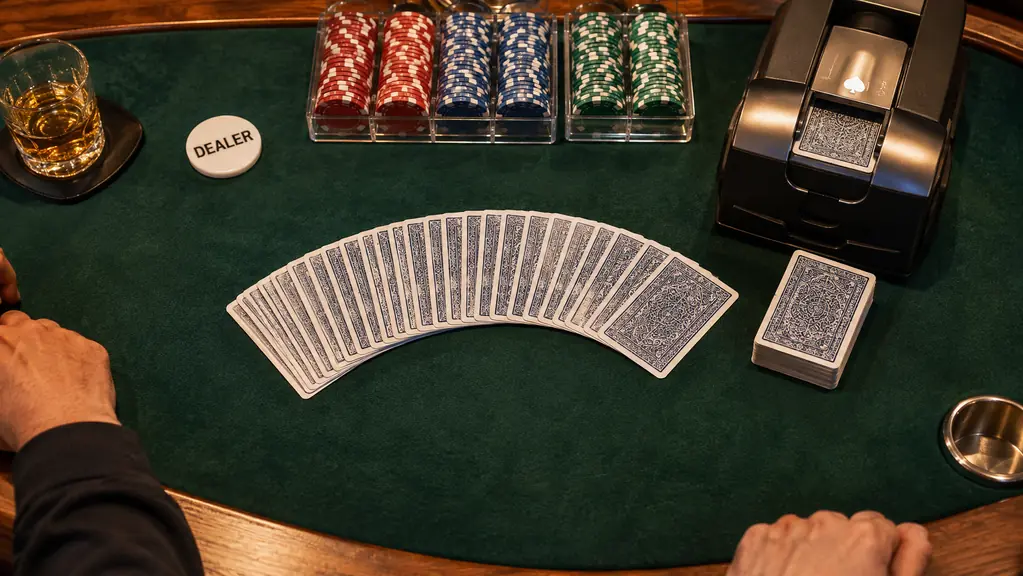
Here is the actual mechanic of a fast home game. The next deck gets shuffled while the current hand is being played, not after it. The dealer runs the machine on the out-of-play deck the second the cards are dealt, not when the hand ends. By the time the pot is pushed, the next deck is ready and the deal happens immediately.
The night I moved the thing, I learned the rest of it by accident. We had been running it between hands, standing there waiting for it to finish, and the game felt no faster than before. Then Ray dealt, slid the finished deck beside the machine, and pressed it while Tom was still deciding whether to call. Nobody looked at it. Nobody waited. The shuffle had moved into the middle of the hand instead of the middle of the night, and that was the whole trick.
That single change is what took my game from about five hands an hour to closer to nine, and it has almost nothing to do with the machine being fast. It has to do with the shuffle landing in dead time. If everybody is sitting there watching the shuffler work, you have lost the rhythm. If everybody is watching Ray take a hand off Tom while the machine runs behind the chip stacks, you have gained it.
Two decks make that possible. If you only own one deck, buy a second before you buy anything else, because a single deck forces the whole table to wait no matter what machine is sitting there. We keep two double-deck sets in rotation. The older set has been washed with dish soap more than once and it is still in play.
Step 5: Keep It Charged and Keep It Off the Bar
The unit is rechargeable, so it does not eat batteries the way the old handheld shufflers did. My routine is simple. I top it up during the week and set it back on the shelf behind the bar next to the Fat Cat case. It comes out Friday, it goes back Saturday morning. Five months in, it has not quit mid-cycle on me.
I do not run it down to nothing on purpose. Monday it goes on the charger in the kitchen. Friday morning it comes back down to the basement and sits on the shelf behind the bar until we set up. The one Friday I forgot to move it, it ran the whole night anyway, and I would rather not find out where the limit is in the middle of a hand.
Storage matters more than people think. My basement gets damp in the summer and I have lost more than one small electronic item down there to it. The shuffler lives on the shelf, not on the floor, and never inside the bag with the folding table where something heavy could sit on it. If yours lives in the chip case, fine, as long as nothing is stacked on top of it.
The cards need more attention than the machine does. When the plastic decks start to feel tacky we wash them with dish soap and warm water, dry them flat, and put them back in rotation. A clean deck runs a clean cycle. A deck with something dried onto one card will make any machine hesitate, and that is not the machine's fault.
What Else Helps
The shuffler is one piece of a system and it will not rescue a table that is disorganized everywhere else. The 48 inch folding top is what makes the room work. Eight seats means nobody is squeezed, and the cup holders keep drinks off the felt, which is the number one cause of a deck that will not run right. Between games it folds in half and leans behind the furnace room door, which is the only reason my wife Diane tolerates it in the house.
The top sits on an old four-foot round kitchen table that has been down there since we moved in. It is not a permanent installation. It comes out Friday afternoon, gets wiped down, and goes back against the wall Saturday morning. Eight seats and cup holders mean nobody has to balance a glass on the felt, and a dry deck is a deck that runs through the machine without a fight.
The chip side matters just as much. We run the Fat Cat 500 chip set in the aluminum case, white ones, red fives, blue tens, green twenty-fives, black hundreds, with the two dealer and blind buttons that came in the case. The Brybelly clear trays do the real work. Two of them hold the bank on the bar so a buy-in takes ten seconds, and the rest hold starting stacks I set before anybody arrives. When the stacks are ready and the bank is counted, the only thing left that can slow a night down is the deal.
One last habit worth building. Give the shuffle to a fixed seat. Whoever is in the small blind runs the machine on that hand. It sounds like nothing, but a standing rule means nobody has to be asked, nobody has to volunteer, and the deck does not sit on the felt waiting for somebody to notice it.
Those forty seconds back, forty times a night
One press, one or two decks, quiet enough to run while the hand is still going. If the shuffle is the slowest part of your Friday night, that is the piece to change first.
Amazon Check Today's Price on Amazon →