
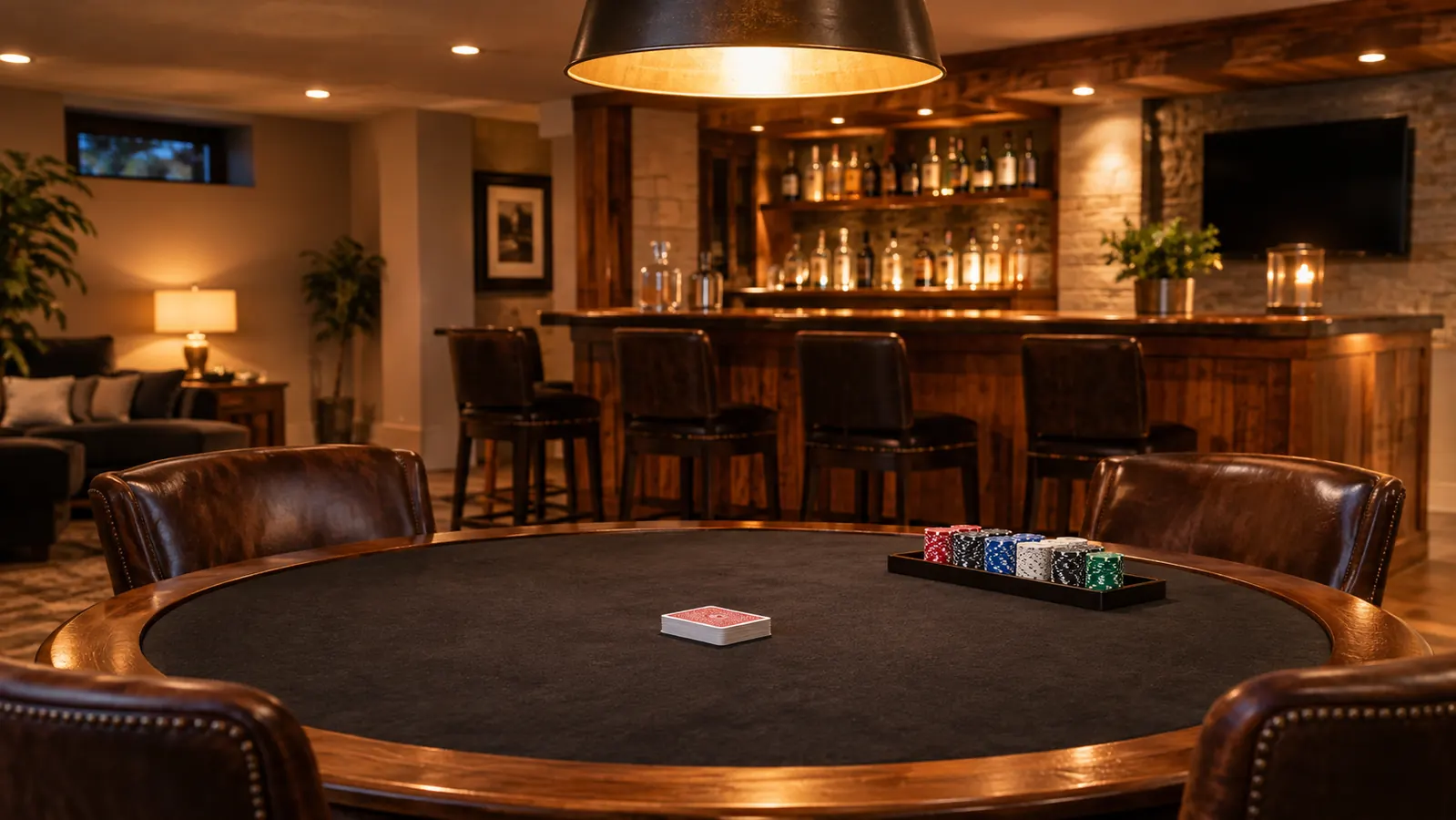
Nine years of hosting Friday night poker in my basement and I have ruined exactly two decks. Neither one died from shuffling. One got creased because a guy at the far end of the table decided to help me pack up and folded a card in half shoving it into the case. The other spent a whole winter in a drawer under the bar, soaking up damp Ohio basement air, and came out looking like a potato chip. If you landed here because a deck has gone soft, sticky or bowed on you, that is the whole story in two sentences. Cards do not wear out from use. They wear out from handling and storage.
The decks we play with now are Copag 1546, poker size, jumbo index, and they have been in rotation for about two years. Before that we burned through paper decks at a rate of roughly one every six weeks. Somebody would spill a beer, the cards would swell at the edge, and by the next game the deck shuffled like a stack of crackers. The switch to plastic changed the math. A plastic deck does not absorb anything, which means almost everything that lands on it can be taken back off. That is the entire reason a Copag deck is worth cleaning instead of replacing. You just have to know what to use, and more importantly, what your buddy should not use on your cards after his third beer.
The deck that survives a wash and comes back to the table
Copag 1546, poker size at 3 7/16 by 2 1/2 inches, jumbo index, 100 percent plastic PVC made in Brazil. Each set is 52 cards plus 2 jokers and a guarantee card, packed in a slim hard plastic case with a divider. Ours have been washed, dried and dealt more times than I can count.
Amazon Check Today's Price on Amazon →Step 1: Get the grease off your hands before it gets on the cards
The number one killer of a playing card is not the shuffle. It is what is on the fingers doing the shuffling. Potato chip dust, wing sauce, the oil off a slice of pizza, hand lotion, the residue from a paper napkin that was already used once. Plastic will not soak that up the way paper does, but it will hold a film on the surface, and that film does two bad things. It makes the cards slide inconsistently, so one card glides and the next one catches. And it grabs grit off the table, which is what actually scratches the faces over a couple of years.
So the first step is not about the cards at all. It is about the room. I keep a stack of cheap paper napkins on the bar and a damp cloth beside it, and before the first hand is dealt the felt gets a wipe and everybody's hands get a wipe. Sounds fussy written down. It takes ninety seconds and it is the difference between a deck that stays crisp for years and one that starts to feel like a diner menu around month four.
I also moved the food off the card table entirely. Chips and dip live on the bar now, three steps away. The regulars grumbled for exactly one week and then got used to it, mostly because nobody misses a hand to go get a chip.
Step 2: Wipe the deck down at the end of every game
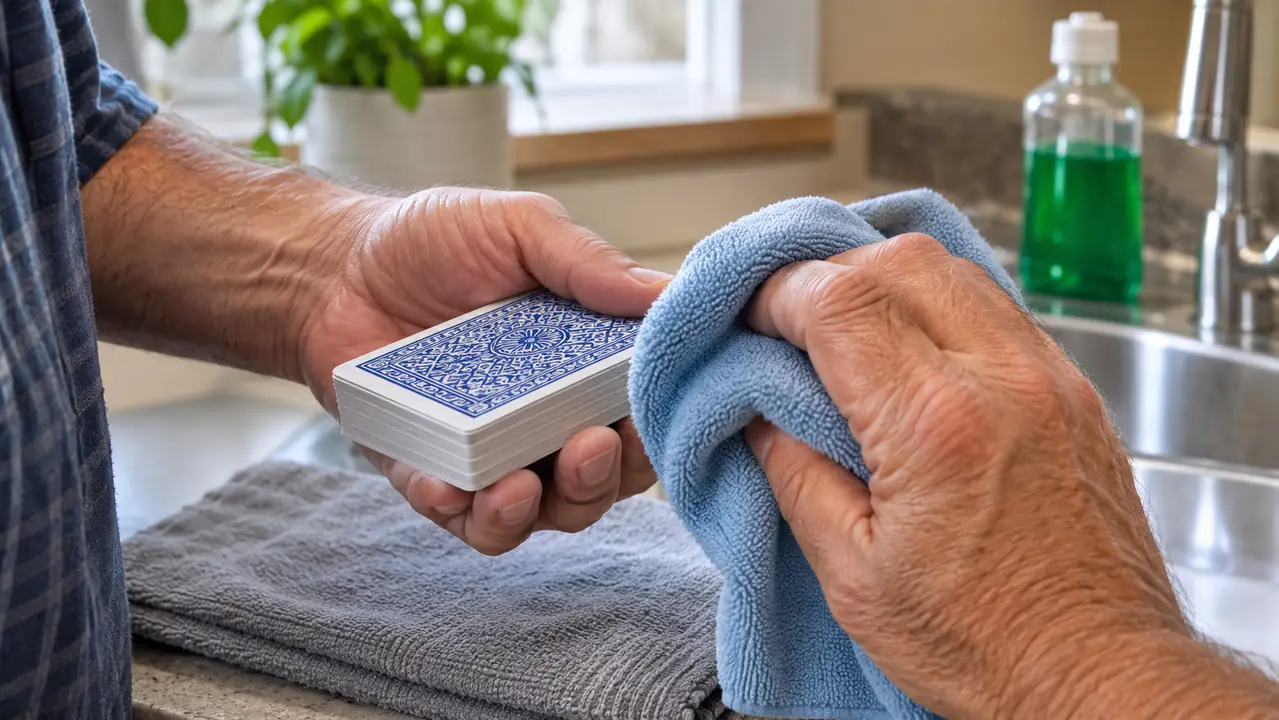
This is the step people skip, and it is the one that keeps the deep wash rare. After the last hand, before the chips go back in the trays, I take a cloth and give each deck a minute. Not a full cleaning. Just enough that nothing gets to sit on the surface for a week.
The method is simple. Square the deck up, then wipe the four edges of the block, which is where the grime collects because that is where hands hold it. Then wipe the top card and the bottom card. Then fan the deck face up in your hand and drag the cloth once across the faces as you fan through. Sixty seconds per deck, and the cards feel new again. The cloth matters more than people think. Paper towel is too abrasive and leaves lint behind in the texture. A microfiber cloth or a well worn cotton bar towel is right. Nothing scratchy, nothing that sheds.
One thing I stopped doing years ago: licking a thumb to separate cards. That is a direct deposit of whatever was last in your mouth, and it is how a deck gets a sticky spot that never quite goes away.
Step 3: When they need a real wash, use dish soap and lukewarm water
Twice a year, maybe three times if the game has been running hard, a deck gets the full wash. Dish soap, lukewarm water, bare hands. No sponge, no scrub brush, no dishwasher despite what one of my shop buddies suggested after two beers. Dish soap is right because it is formulated to cut grease and it rinses clean. Fancy hand soap is not, because it leaves a moisturizing film, and that film is exactly what you are trying to remove.
Lukewarm is not a suggestion, it is the whole ballgame. Hot water softens PVC, and a softened card that gets handled while it is soft will take a set and stay that way. If the water is uncomfortable on your hands, it is too hot for the cards.
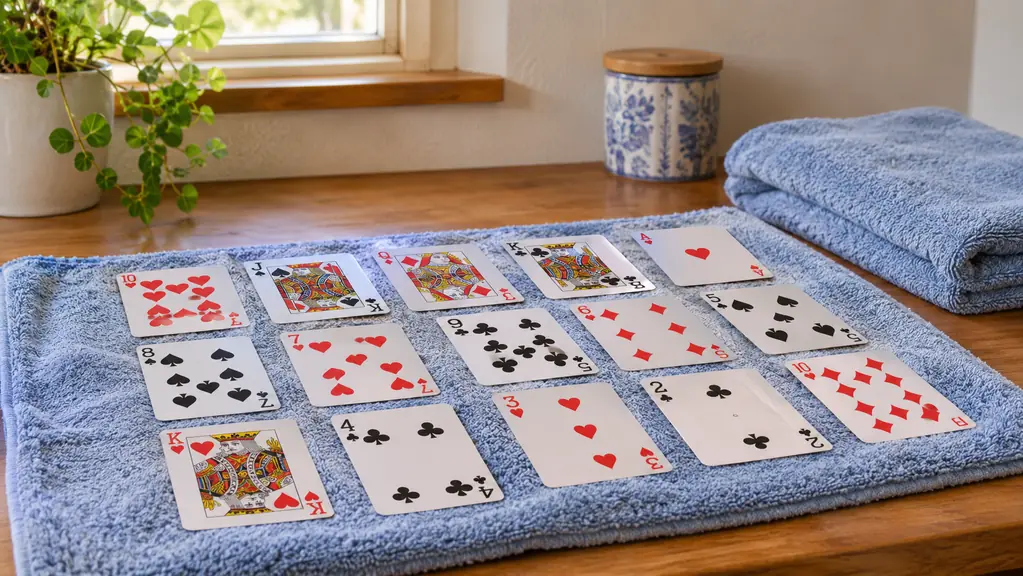
Here is the routine I use. Put two inches of lukewarm water in the sink with one drop of dish soap, no more. Spread the cards out in the water face up and swish them gently with your hand. Then take each card, rub it between thumb and fingers on both sides, and lay it face up on a clean towel on the counter. Work through all 54 cards, which is the 52 plus the two jokers in a Copag set. It takes about fifteen minutes and it is oddly satisfying, like cleaning a rifle. When you are done, drain the sink and rinse it, because you will want it later.
Step 4: Dry them flat and give them a full day
This is where people ruin a deck they just washed correctly. Do not stack them wet. Do not put a wet deck between two heavy books and call it pressing, because all you are doing is pressing the moisture into the middle of the stack where it cannot get out. And do not sit there with a hair dryer, which is the same mistake as hot water only faster.
I lay all the cards out face up on a bath towel on the bar, in a single layer, edges barely overlapping when I run short of counter. Then a second towel over the top if the basement is dusty, and I walk away. Twelve hours minimum. Twenty four if it is July and the dehumidifier is struggling, which around here it usually is. A box fan running in the room helps a lot. Direct heat from a register or a space heater does not, and I have watched a guy warp a good deck proving it.
Check one card before you reassemble. Bend it gently between two fingers and let it go. If it snaps back flat, the deck is dry. If it feels rubbery or stays slightly curved, give it another few hours. Reassembling a damp deck is how you get the potato chip result without ever touching a drawer.
Step 5: Store them flat, in the case, above the floor
Storage is the other half of the job, and it is where my one genuinely ruined deck went wrong. The Copag set comes in a hard plastic case with a divider down the middle, and that case is not packaging, it is equipment. The divider keeps the two decks from pressing on each other, and the hard shell keeps them from getting sat on, which is the most common death of a deck that lives in a room with furniture in it.
Keep the case off the concrete. Mine sits on a shelf behind the bar, about chest height, closed, divider in, both decks squared and flat. Not in a drawer under the bar where the pipes sweat in summer. Not in the garage. Not in the car, ever, because a car in an Ohio August is an oven and an oven is how a plastic deck gets its permanent wave. If you have a damp basement like mine, the shelf is doing more for those cards than any cleaning product on the market.
The last piece is weight. Do not leave a deck sitting under a stack of chip trays or a case of beer. Plastic has a memory. Sit something heavy on a deck for a month in a humid room and it will come out with a bow you cannot wash away.
A deck does not wear out from shuffling. It wears out from what is on your hands while you shuffle, and where you leave it when the game is over.
What Else Helps
Rotate two decks instead of wearing out one. We keep two double deck Copag sets going, and one of them has been washed with dish soap more times than I would admit to, and it is still in play. Rotating gives each deck a week to sit flat and dry out completely between games, and it means a single creased card does not end your night.
Use the jokers as cut cards, which is what they are for in a home game, and stop cutting the deck with a thumbnail. I have watched guys dig a groove into the edge of a card trying to lift half a deck. Slide the cut card under and lift. Small habit, years of difference.
Watch the summer stuff. Bug spray and sunscreen on a player's hands will soften the edges of a plastic deck faster than anything else I have seen, and I had a set come back from a fishing trip that proved it. If the game moves outdoors, wash hands after the spray goes on. And if a card does get creased, pull it out of the deck and set it aside rather than shuffling it back in, because one bent card will put a wobble into every shuffle for the rest of the night.
None of this is complicated. Wipe the deck at the end of the night, wash it twice a year with dish soap and lukewarm water, dry it flat for a full day, and keep it in the case on a shelf. That routine is the reason a plastic deck outlasts a paper one by such a wide margin that the comparison stops being interesting.
Stop replacing decks. Start washing one.
Copag 1546, poker size, jumbo index, 100 percent plastic PVC. Double deck set with a slim hard case and divider so the cards stay flat between games. It is the deck I hand to a table of six guys who eat wings while they play, and it comes back every week.
Amazon See the Copag 1546 on Amazon →