

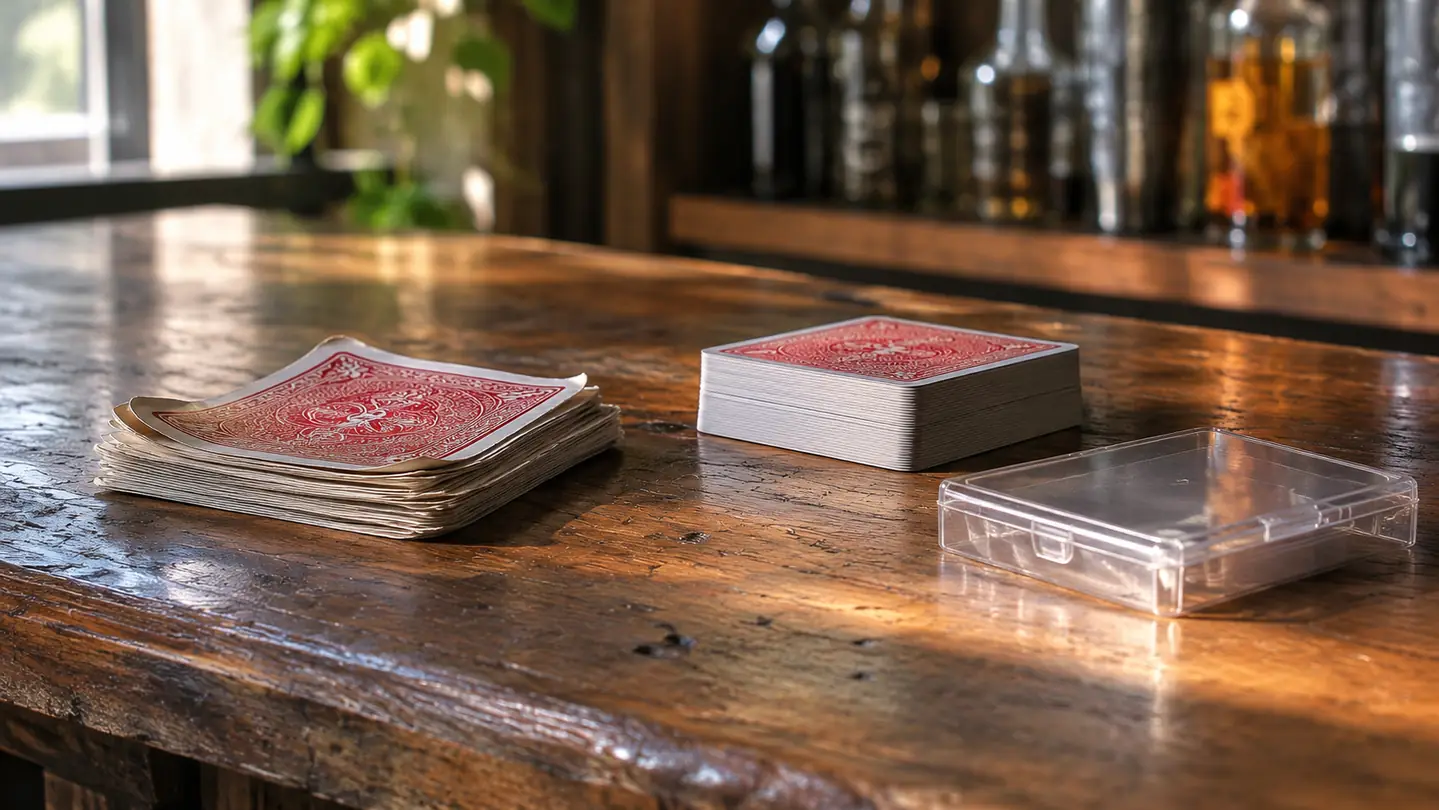
Ray bent the corner of the ace of spades last month and nobody said a word about it. We just dealt around it, the way you do, and by the end of the night the whole deck had that soft, floppy feel paper gets once it has been handled for a few months. That deck was not old. The Copag set sitting in its case behind the bar has been in play for about two years, and the ace of spades in that one still lies flat on the felt.
So the short answer: for a game that meets every Friday, the plastic cards are worth it, and Copag is the set I keep buying. For one afternoon of cards at a picnic table, paper is fine and I am not going to spend your money for you. Here is what I mean by worth it. My game is six guys in a basement, small stakes, chips in the middle for fun. We play about forty Fridays a year, minus the summer weeks when I am out on Lake Erie after walleye. That is a lot of shuffling and a lot of thumbs on card edges. Paper decks in that rotation were lasting me maybe two months before the corners went soft or somebody set a beer down on the nine of clubs.
| Copag 1546 Plastic | Paper Playing Cards | |
|---|---|---|
| Durability through a season | Two years in and still deals flat. One set has been washed with dish soap and went back into rotation. | Corners soften within a couple of months of weekly play. |
| Feel in the hand | Slick for the first couple of weeks, then settles into a crisp snap. | Soft and grippy right away, goes floppy fast. |
| Reading the rank across the table | Jumbo index, readable at arm's length. | Standard index in most packs, fine up close. |
| Storage between games | Rigid plastic case with a divider, slim enough for a shelf. | Paper tuck box that crushes by the second month. |
| A spilled drink | Wipe it down, or wash it and dry it flat. | One ring on one card and the deck is done. |
| One afternoon of cards a year | More deck than the job needs. | Cheap, light, and losing one does not sting. |
| Writing on a card | Marker smears and will not come off clean. | Write a score on the back and toss it after. |
| Shuffling with stiff hands | Stiff out of the case and slick until broken in. | Soft immediately, easier for hands that do not shuffle much. |
Read that table honestly and the shape of it is clear. Plastic wins anything that involves repetition: forty Fridays a year, six sets of thumbs, a spilled drink now and then. Paper wins anything that involves one afternoon and no attachment to the deck. There is no version of this where paper is the better card. There is a version where paper is the better buy, and that is the version where you play twice a year and the deck lives in a drawer.
Where Copag Wins
Durability is the whole argument, so start there. Copag makes these from 100 percent plastic PVC in their own facility in Brazil, and the difference shows up around week three, not week one. A fresh paper deck feels good for a few nights. It is the fourth month that separates the two, when the paper has gone soft, the corners have that fuzzy white break line, and the whole deck has a curve to it that will not flatten out. I keep a note taped inside the bar cabinet, mostly because I am that kind of person: paper deck bought in March, soft by Memorial Day. The plastic set that went into rotation two years ago has small notches on the corners now, and it still lies flat and riffles clean.
Readability is the second thing. I run the jumbo index version, and Tom, who sits at the far end and refuses to wear his glasses, can call the rank without picking the card up. Across four feet of felt that index is the difference between reading your hand and squinting at it. That is not a small thing at a table of six. The cards are poker size, 3 7/16 by 2 1/2 inches, so nothing about the deal changes, and each deck is 52 cards plus two jokers and a guarantee card. The set arrives as a double deck, which is what a home game actually needs: one in play, one already shuffled for the next hand.
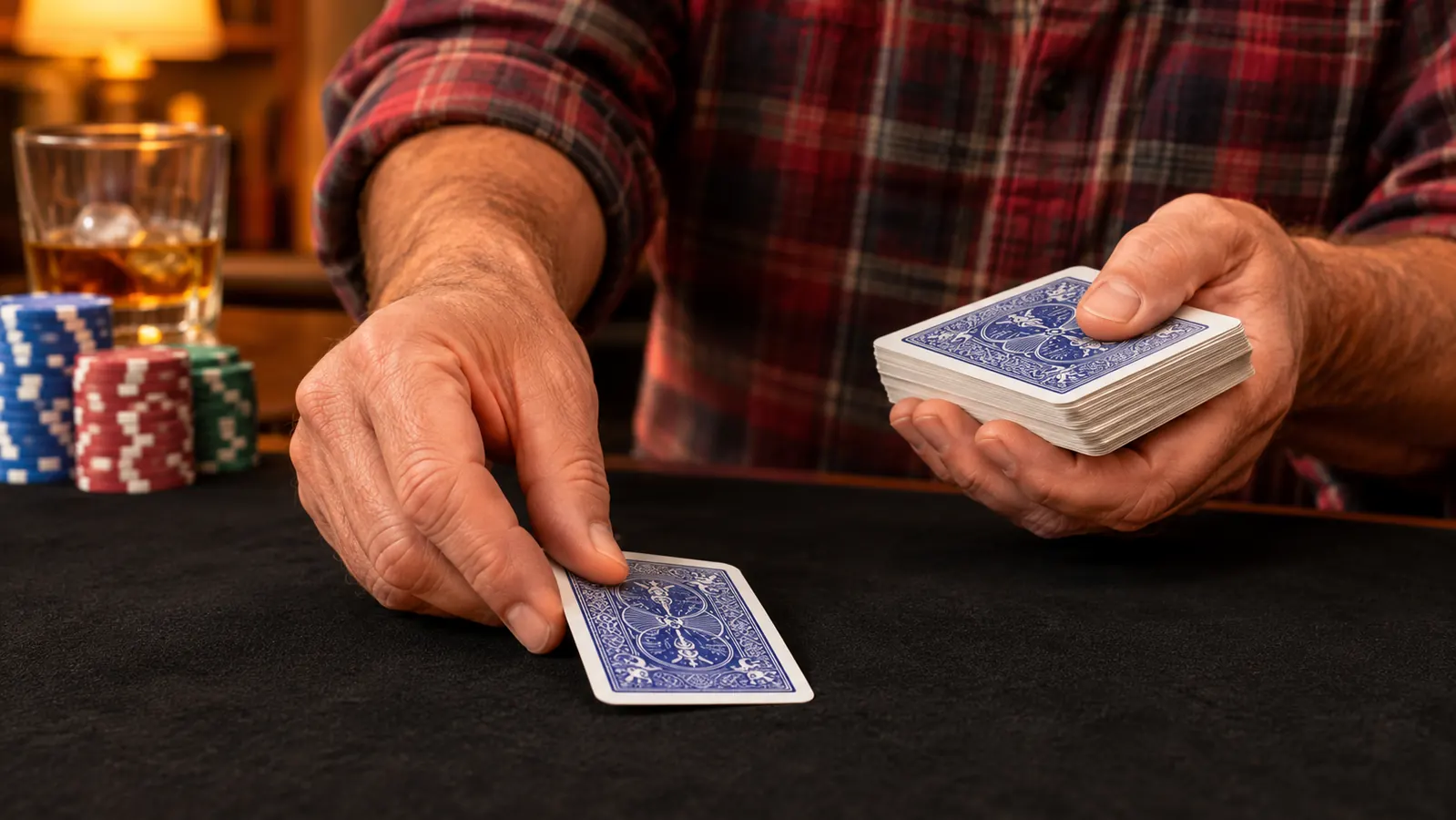
The last thing plastic does that paper cannot is pitch. We deal fast, and a paper card thrown across the felt tumbles, catches an edge and slides. A plastic card flies flat and stops where it lands. I first noticed it dealing to Tom at the far seat, where a paper card thrown that distance lands wherever it feels like. Small thing. You notice it on every single hand, and once you notice it you cannot un-notice it.
Where Paper Cards Win
Paper is cheap and I am not going to pretend otherwise. If your game is twice a year at a family gathering, buy paper, put it back in the drawer, and forget about it. It is light, it costs almost nothing, and if a kid wanders off with the queen of hearts nobody grieves. A paper deck also takes a marker. We used to keep a running score on the backs of the low cards in a euchre deck, and that worked fine. Marker on plastic smears and stays smeared.
And here is the honest one that the plastic crowd skips. New plastic is slick and stiff. Out of the case the cards want to slide off each other, and the first riffle I tried sent half the deck across the felt. It takes a couple of weeks of Fridays to settle. If somebody at your table has hands that do not shuffle much, paper is softer and more forgiving right away, and that is a real advantage, not a courtesy. It is the reason I bought a shuffler instead of telling Ray to practice.
The Set That Is Still Dealing Flat After Two Years of Fridays
Copag 1546, double deck, jumbo index, poker size at 3 7/16 by 2 1/2 inches, in the slim hard plastic case with a divider. 52 cards, two jokers and a guarantee card in each deck.
Amazon Check the Copag 1546 Set on Amazon →Two years of Fridays, one dish soap wash, and the ace of spades still lies flat on the felt.
The Case Does More Work Than You Think
I did not expect to care about the box, and I care about the box. The set comes in a hard plastic case with a divider down the middle, slim enough that it goes on the shelf behind the bar next to the chip trays without eating a whole shelf. The case measures about 8 by 6 by 3.5 inches, and that is a shelf gap I did not think anything would fit in. Two decks ride in it, one on each side, and the divider keeps them from grinding against each other in storage. The paper decks I used to buy came in tuck boxes. By the second month the flap was torn and the box had a lean to it, and the cards inside were picking up the lean.
Then it hit me that half of what people call a durable deck is really a deck that got stored right. Cards that live loose in a drawer get bent corners from everything else in the drawer. Before the case I tried the usual things. A rubber band around the deck, which put a slow curve in it that never came out. A zip-top bag, which trapped whatever was already on the cards and made them smell like a cooler. Both were worse than leaving them alone. Cards that go back into a rigid case with a divider do not have that problem. The case is part of what you are buying, not packaging you throw away, and it is why the Copag set looks the same in year two as it did in month one.
Two Years of Fridays, One Set Still in Play
The switch happened about two years ago, and the trigger was a beer ring on the seven of diamonds during a hand Ray still brings up. I had a paper deck that was already soft, and I decided I was done buying decks twice a season. Now I keep two double deck sets of the Copag in rotation. The older set is the one that has been washed. The newer one has never been wet and looks about the same as the day it came out of the case.
The wash was not a plan. It was a Friday in October, the night the furnace kicked on for the first time that fall, and a glass went over during the second deal. Nine cards caught most of it. I wiped them down, gave them a lukewarm rinse with a drop of dish soap, spread them on a dish towel, and let them sit overnight. They came back fine, a little slicker for one night, then normal. I would not make a habit of it. But the fact that you can do it at all is the whole difference. Paper would have been a stack of wet crackers.
What I expected to fail first was the print on the face cards. Two years in I cannot point to a card where the ink has gone. That is the part that surprised me, and I am a guy who expects to be disappointed by the things he buys.
I used to buy a paper deck or two a season. Over two years that is four or five dead decks in a drawer with a rubber band around them, kept for no reason I can name. The plastic set is still the set. I am not going to do arithmetic at you, because the money was never the big number. The annoyance was. Running out on a Friday afternoon to buy cards because last month's deck has a crease in it is the kind of small errand that turns a hobby into a chore.
Shuffling, and the Slick First Week
Plastic needs a break-in, and I want to be straight about the first week. The cards slid past each other, I dropped more than I dealt, and I said a few things under my breath. Two weeks of Fridays and they had settled into a nice snap. Ray's hands stiffen up with arthritis, so about five months ago I bought a battery shuffler that sits next to whoever is dealing. It takes one or two decks, runs on batteries, and has a one-press auto mode plus a manual one for when somebody wants to feel useful. Plastic feeds through it without the corners catching. A paper deck with bent corners jams it. That was the last argument I needed.
Who Should Buy Which
If you host a regular game, even once a month, buy the Copag. That is the case I will argue. You handle the cards often enough that a deck which lasts years instead of weeks pays you back in the first season, and you stop thinking about cards at all, which is the point. Get the double deck set. Having a second deck already shuffled while the first is in play does more for the pace of a game than most of the gear I have bought.
If you play twice a year, or your game is a camp table with a cooler beside it, paper is fine. Buy paper. Do not let anybody talk you into gear you will not wear out. Same if you have kids who will use the cards for something other than cards, or if you like to scribble scores on them. And if your table has somebody whose hands cannot work a stiff new deck, start with paper and let them deal, or buy the shuffler along with the plastic.
The middle case is most of you: you play every couple of weeks, and you are tired of buying paper decks. That is where the plastic set earns its keep fastest. You get past the slick first two weeks, the deck stops being a thing you think about, and the next time somebody bends a corner it just springs back. Two decks, one in play and one ready, in a case that keeps them flat between Fridays. That is the whole upgrade. Not a different game, just one less small failure on a Friday night.
Buy It Once, Deal It for the Next Ten Years
Copag 1546, 100 percent plastic PVC, jumbo index, double deck set in the hard plastic case with the divider. The cards your Friday game will still be shuffling long after the paper is in the drawer with a rubber band around it.
Amazon Check the Copag 1546 Set on Amazon →