

The first thing I tell anyone who asks about the Copag 1546 is that a deck of cards is the last thing you notice at a poker table until it starts failing you. For years my Friday game ran on paper decks. They were fine for a while. Then the corners got soft, a beer ring showed up on the ace of spades, and by the end of the night half the table was trying to read a card that looked like it had been through a wash cycle. I switched to the Copag 1546 about two years ago. I have two double-deck sets in rotation now, and the oldest set has been washed with dish soap after a spill and is still in play. That is the short version. The longer version is what this review is for.
Here is the part nobody tells you. Plastic cards do not make you a better host. They do not fix a wobbly table, settle an argument about a raise, or teach Ray to stop shuffling like he is closing a paint can. What they do is remove one small recurring annoyance from a night that is supposed to be fun. For me that was enough. If you are shopping for a deck that feels like a magic trick, keep looking. If you want cards that survive a basement game with six guys, cold drinks, and a card table that gets folded up twice a month, the Copag 1546 is worth a hard look.
The Quick Verdict
A durable, readable plastic deck that solved my bent-card problem, with a jumbo index that takes some getting used to.
Amazon Check Today's Price →The deck that stopped my Friday game from dealing with bent corners
Two decks, two jokers each, jumbo index, and a hard plastic case that keeps them together between games.
Amazon See the Copag 1546 on Amazon →How I've Used These Cards
My game is six regulars in a finished basement outside Toledo. We play small stakes for fun. I have been hosting about nine years, and the table has been upgraded piece by piece. The cards were the last piece I changed, mostly because I got tired of buying paper decks and watching them die. I bought my first Copag 1546 set about two years ago. A double-deck set gave me one deck in play and one deck waiting, which is how I like to run a table. The regulars are my brother-in-law Ray, my neighbor Tom, and three guys from my old shop. Nobody is there to grind out a living. They are there to argue about a bad call and eat too many pretzels.
The oldest set has seen every game since, plus a few summer sessions when the game moves to every other week because I am out on Lake Erie chasing walleye. It has been dropped, shuffled, dealt, and wiped down. After one spill I washed the cards with dish soap, dried them on a towel, and put them back in the case. I did not do that as a test. I did it because I did not want to throw away a deck over a spill. They are still in the rotation. That is the most useful thing I can tell you about a plastic deck. It can take a dumb accident and keep going.
The second set lives in the case most of the time. I rotate it in when the first set is drying or when I want a fresh-feeling deck for a bigger game. The case has a divider and holds both decks, and that is all I ask from a card case. It sits on the shelf behind the basement bar with the chip trays. I do not baby it. I do not stack heavy things on it. It has held up.
One thing I have learned from running a weekly game is that consistency matters more than novelty. Players like knowing where the cards come from, how they feel, and how they read under the light. A deck that changes every few months never gets that comfortable. The Copag 1546 has been in the same spot on the shelf for two years, and that alone has made the game smoother. Guys do not have to adjust to a new deck every time someone spills a soda.

What the Copag 1546 Gets Right
The Copag 1546 is 100 percent plastic PVC, made in Brazil, and the cards are poker size at 3 7/16 by 2 1/2 inches. Each deck has 52 cards and 2 jokers. The set comes with a hard plastic case and a divider with the Copag symbol. Those are the facts from the listing, and they match what I have in my hand. The plastic is the part that matters. It does not get soft at the corners the way paper does, and it does not soak up a spill and swell. That means a deck can survive a night that would have sent a paper deck to the trash.
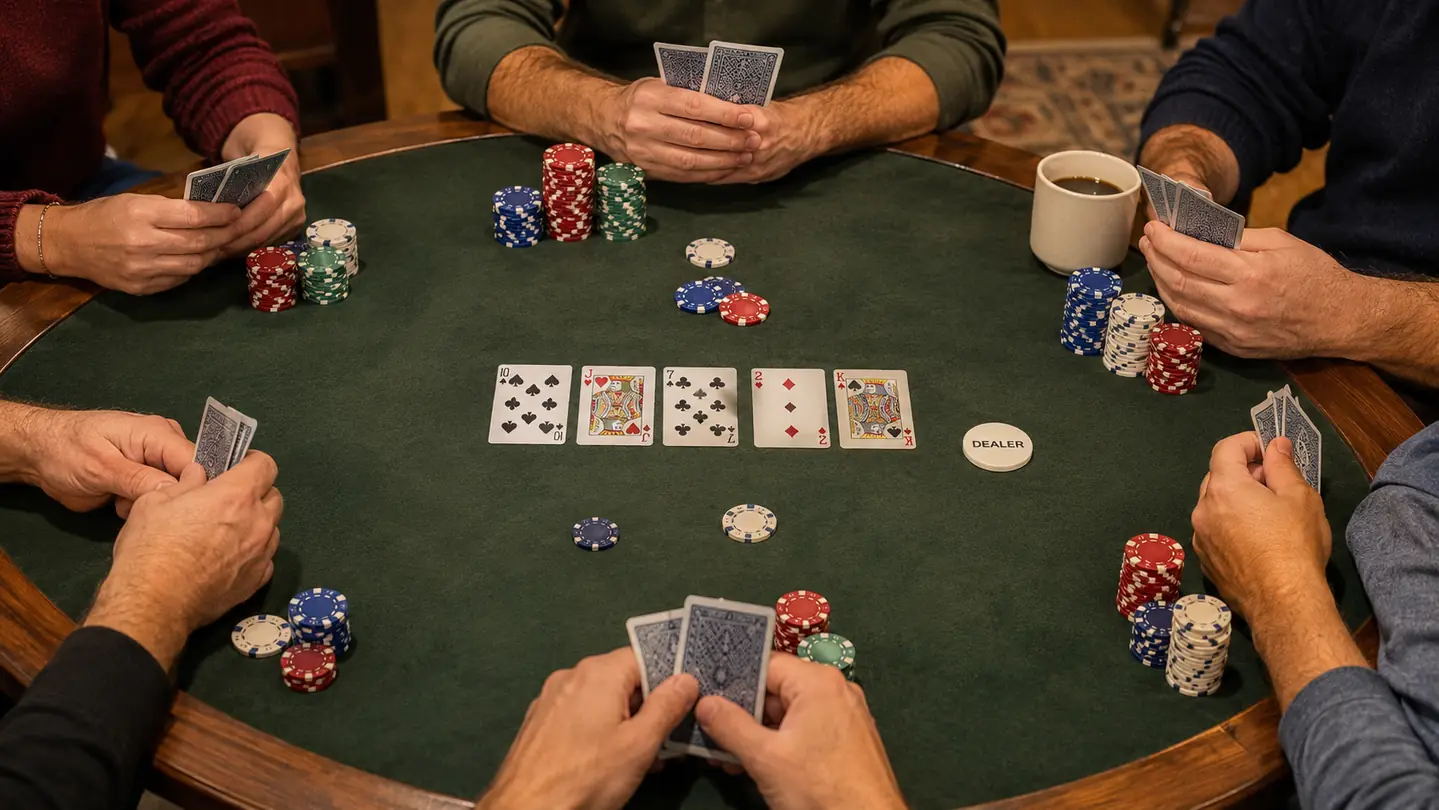
The jumbo index is the other big feature. The numbers and suit symbols are larger than on a standard deck, which makes them easier to read from across the table. My table top is a 48-inch folding octagon, and with six players there is enough distance between seats that a standard index can get squinty under basement light. The jumbo index fixed that for us. Ray is 68 and his eyes are not what they were. Tom is 61 and refuses to wear his glasses at the table. Neither one has complained about reading these cards. That is a small win, but it is the kind of small win that keeps a game moving.
The case is simple and does what it should. It is hard plastic, it has a divider, and it keeps the two decks separate. I have had cheaper cases crack at the hinge. This one has not. I do not toss it around, but it does get moved from the shelf to the table and back every week. That is enough use to show whether a case is going to hold up. The divider also means I can keep one deck face up and one face down without them getting mixed together, which sounds like a minor thing until you have dealt with a mixed deck at 11 p.m.
What Nobody Tells You About Plastic Cards
Plastic cards are not indestructible. They can scratch. They can get slick. They can pick up a smudge from a chip stack if someone has been eating wings at the table. The difference is that they do not fail in the same way paper fails. A paper deck gets a soft corner, then a crease, then a card that is marked without anyone meaning to mark it. A plastic deck might get a scuff, but it still deals and still reads. That is the trade. You are not buying a forever deck. You are buying a deck that gives you a lot more Fridays before you have to think about it.
The first few games with the Copag 1546, the cards were slicker than the old paper decks. A couple of guys fumbled a deal. That settled down after a few nights. I am not going to tell you they feel exactly like paper. They do not. They have a firmer, springier feel, and they make a different sound when they hit the table. Some people love that. Some people do not. If you are attached to the soft feel of a paper deck, give yourself a few games before you decide. Do not judge them on the first hand.
Another thing nobody tells you is that plastic cards make you a little more willing to enforce the small rules. I do not mean being a hard case. I mean that when a card gets a spot on it, you can wipe it and keep going instead of pretending not to see it. When a deck gets bent, you can replace it without feeling like you just burned money. That sounds small. Over a few years of weekly games, small things add up. A host who is not annoyed about the cards is a host who is more likely to keep hosting.
The last thing is the sound. Paper cards make a soft riffle. Plastic cards make a sharper click. In a basement with six guys talking over each other, that click is actually useful. I can hear a deal from the kitchen. I know when the cards are being shuffled and when someone is just fidgeting. That is not a feature on the listing. It is just something I noticed after a couple of years. If you play in a quiet room and you hate extra noise, it might bother you. If your game sounds like mine, you will barely notice it.
The Jumbo Index Tradeoff
The jumbo index is not for everyone. If you play with four people around a kitchen table and everyone has good eyes, a standard index looks cleaner. The jumbo index puts more ink on the card, and some players find it busy. I have one regular who prefers a standard deck because he says the big numbers make him feel like he is playing bingo. He still plays with these cards every week, so take that for what it is worth. The cards work. They are just not invisible.
For my game, the tradeoff is worth it. We have six seats around a 48-inch table top, the light over the table is not a casino spotlight, and two of my regulars are past 60. The jumbo index means fewer pauses, fewer squints, and fewer questions about what card was just played. If your group is younger or smaller, a standard index might be the better fit. If your group looks like mine, jumbo is the practical choice. It is not about style. It is about keeping the game moving.
Where They Fit in My Basement Game
I run a Fat Cat 500-chip Claytec set in an aluminum case. The chips are set up for small stakes, and the case came with two dealer and blind buttons. The cards, the chips, and the table top are the three things I use every game. The Copag 1546 fits that setup without any fuss. Poker size is the standard size for a game like mine, and the cards sit flat on the felt. I have used them with the Trademark Poker 48-inch folding octagon table top, and the size is right for that surface.
About five months ago I added a KPAW automatic card shuffler. Ray's hands stiffen up with arthritis, and shuffling had slowed the game to a crawl. The shuffler runs in one-press auto or manual mode and handles one or two decks. I am not going to pretend it is silent. It is not. But it keeps the game moving, and it has not damaged the Copag cards. That was my worry. A shuffler can chew up a cheap deck. So far, so good with these.
The Brybelly clear acrylic chip trays hold the bank on the bar between games, and the rest hold starting stacks when I set up. The leftover trays live in the gap in the Fat Cat case. None of that has anything to do with the cards, except that a game night is a system. When one part of the system stops working, you notice. The Copag 1546 has been the part I do not think about, which is exactly what I want from a deck. It is not the star of the table. It is the thing that lets the table run.
What I Liked
- 100 percent plastic PVC, so spills wipe up instead of soaking in
- Poker size, 3 7/16 by 2 1/2 inches, fits standard tables and shufflers
- Jumbo index is easy to read from across a 48-inch table
- Each deck has 52 cards and 2 jokers, and the set includes a hard plastic case with a divider
- Survived two years of weekly use and one dish soap wash in my basement
Where It Falls Short
- Jumbo index can look busy if your group prefers standard
- New cards are slick for the first few games
- The case holds cards, not chips or buttons
- Not the deck for players who still bend corners
Two years in, the oldest Copag set in my rotation has been washed with dish soap after a spill and is still the deck we deal from on Friday nights.
Who This Is For
This is for the host who is tired of buying paper decks and watching them die. If you run a home game with friends, if the table gets used often enough that cards are a consumable, and if you want a deck that can be wiped down and put back in the case, the Copag 1546 makes sense. It is also a good fit if your group has players who need a larger index. The jumbo index is the reason I bought this version, and it is the reason I would buy it again. I am not saying it will make your game better. I am saying it will stop one small thing from making your game worse.
It is also for the player who likes a firm card. If you have ever picked up a plastic deck and thought it felt like a piece of office equipment, this is not that. The Copag 1546 has a springy feel and a clean snap when you deal. It is not soft like paper. It is not flimsy like a cheap promotional deck. It feels like a tool that is meant to be used. That matters if you play often. A deck that feels good in the hand gets dealt with more care, and a deck that gets dealt with care lasts longer.
And it is for the guy who does not want to think about cards anymore. I have a system. I have two sets. I have a case. I have a shelf. I have a Friday night. The Copag 1546 fits into that system without asking for attention. If you want a deck that you can buy, use, wipe down, and forget about, this is a reasonable choice. If you want a deck that becomes a hobby of its own, there are fancier options. I did not want a hobby. I wanted cards.
Who Should Skip It
Skip it if you want a standard index and nothing else. The jumbo index is the whole point of this version. If your group has good eyes and plays on a small table, a standard index deck will look cleaner and feel more traditional. Skip it also if you are rough on cards. Plastic is tough, but it is not a license to bend a deck in half. If your game includes guys who still riffle the cards like they are trying to shuffle a phone book, no deck will last forever. The Copag 1546 will last longer than paper, but it is not armor.
Skip it if you want a case that holds chips, buttons, and a cut card. This case holds two decks and a divider. That is it. I keep my buttons in the chip case, and that works for me. If you want one box for everything, you will need to look at a different setup. None of that is a knock on the cards. It is just what the product is. A hard plastic case with a divider is a good thing for cards. It is not a carrying case for a whole game.
If your Friday game is hard on paper decks, start here
The Copag 1546 double-deck set gives you two poker-size decks, jumbo index, and a hard case that keeps them together. It is the deck I reach for in my own basement.
Amazon See the Copag 1546 on Amazon →