
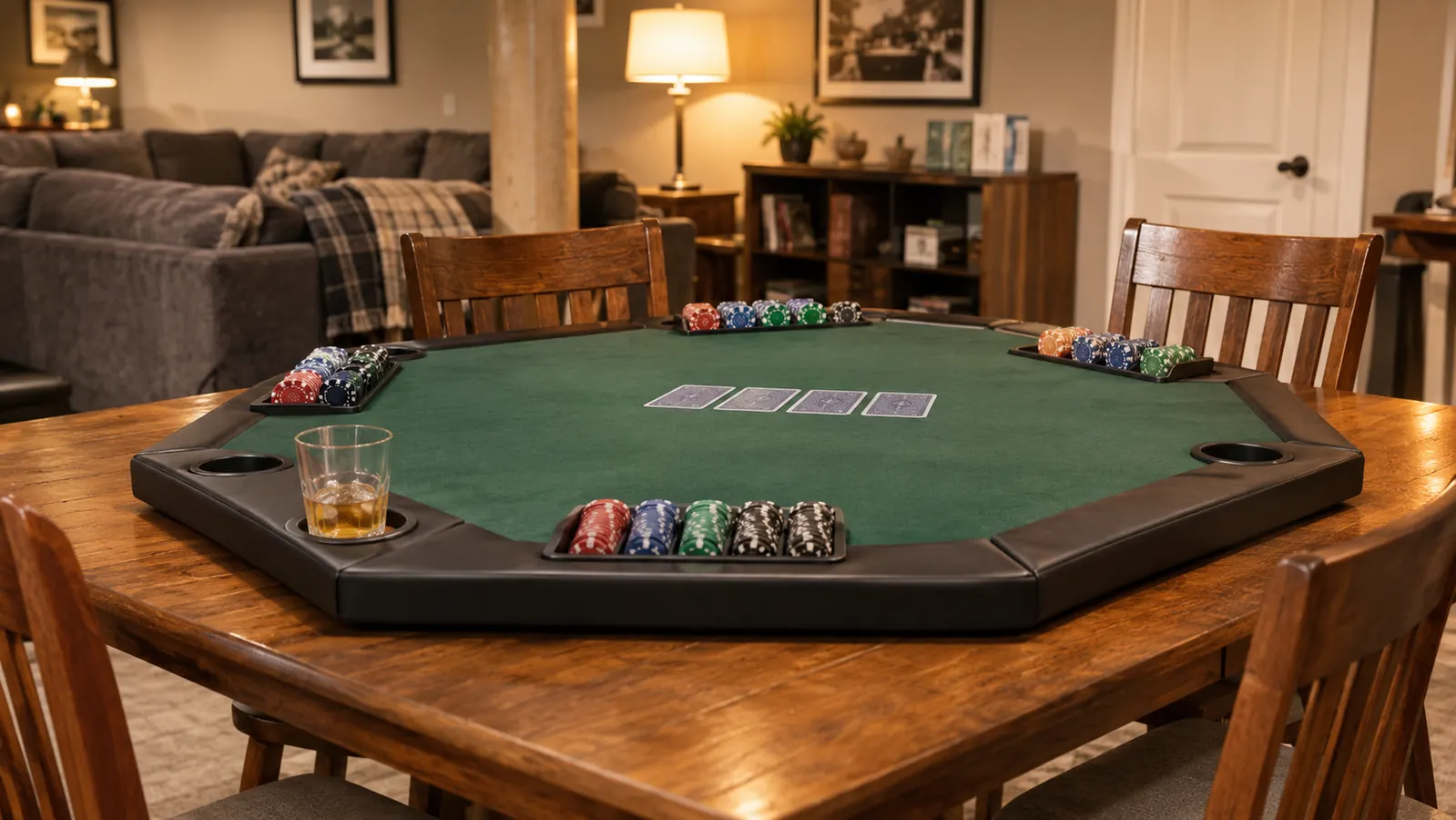
My basement has one table in it, and that table has to do three jobs. It is where the mail gets sorted, where the snacks go on a Friday, and where the cards get dealt once everybody shows up. For the first few years I tried to make that third job work with a felt cloth, and it never did. Cards slid off the edge every time somebody reached for the pot. Chips rolled into the seam where the table folds. The cloth itself bunched into a wad by nine o'clock, and I spent more of the night smoothing felt than playing cards.
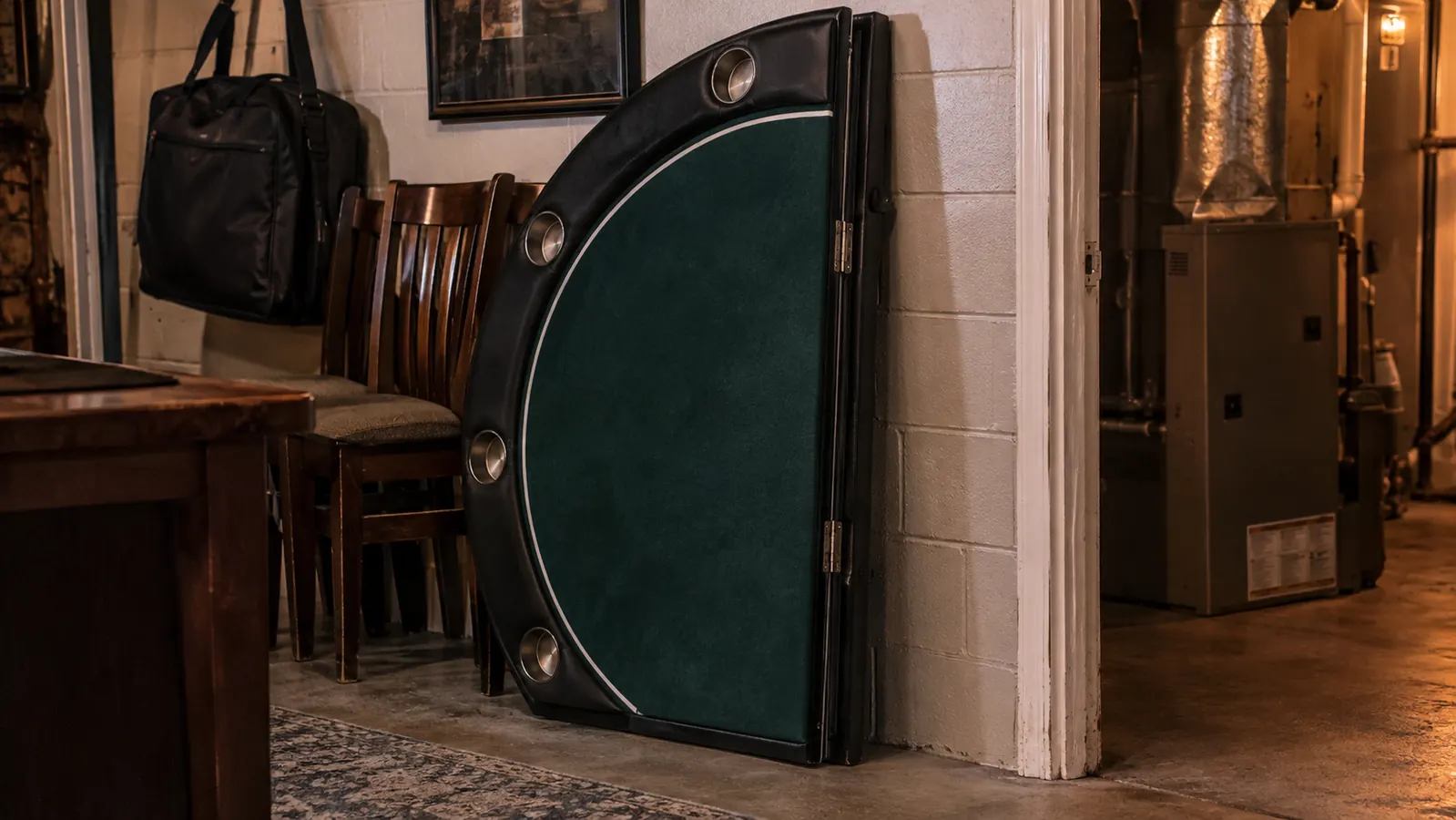
What fixed it was not a new piece of furniture. It was a 48-inch octagonal folding topper from Trademark Poker, solid wood and vinyl, a hair over twenty pounds, and it goes on top of the table I already owned. Setup is about fifteen seconds. Teardown is about the same. When the game breaks up it folds in half and leans against the wall behind the furnace room door, and the table goes back to being a table. After two years of Fridays I still have no complaints worth writing down, which for a piece of hobby equipment is close to a compliment.
Here is the whole process in the order I actually do it, including the parts I got wrong in the first month. None of it is complicated. Most of it comes down to measuring before you buy and slowing down for thirty seconds when you set the thing down, and the rest is habit.
Your dining table is fifteen seconds from being a card table
The Trademark Poker 48-inch folding topper sits over the table you already own, seats eight, and folds in half for storage. Built-in cup holders and chip trays keep drinks and stacks where they belong.
Amazon Check Today's Price on Amazon →Step 1: Measure the Table You Already Own
The Trademark Poker topper measures 48 by 48 inches across the octagon. You want the table underneath to be close to that footprint, not much smaller and not much bigger. Mine is an old round kitchen table that measures four feet across, which works out to the same 48 inches, so the edges line up almost flush all the way around. That is the case the topper was built for, and it is why I never bothered buying a dedicated card table.
Get a tape measure out and check both directions, because a table that is 48 inches one way and 40 the other leaves an overhang on two sides and not the other two. A couple of inches of overhang is fine. Eight inches is not, because the topper turns into a lever, and a grown man leaning on the edge of a lever can tip the whole thing. If your table is under about 40 inches in either direction, cut a sheet of plywood to match the topper and put that down first. It looks like a workshop solution because it is one, but it works.
While the tape is out, measure for storage. Folded, this topper is 49 by 2 by 25 inches, so it wants a slot roughly four feet long and a couple of inches deep. Behind a door, along a basement wall, in the gap beside the furnace, all of those work. If you honestly have nowhere to lean something four feet long, sort that out before you spend anything, because storage is the thing that decides whether a topper gets used every week or turns into clutter leaning in a corner.
Step 2: Clear the Table and Check What Is Underneath
Take everything off. Not just the cards and chips, all of it, including the centerpiece and the stack of mail that lives there during the week. You want a bare surface so the topper sits flat, and so you can feel with your palm whether the table underneath is true. This takes a minute and saves you a night of a wobbly table that nobody can explain.
Wipe the table down and let it dry all the way before the topper goes near it. The care instruction for this piece is a dry cloth, so do not set it down on a damp table and do not go at the vinyl with a wet rag thinking you are helping. Run your hand across the surface, corner to corner. If the table has a leaf seam, a warped board, or a high spot in the middle, you will feel it as rock in the topper when you press down later. Better to find it now than in the middle of a hand.
If your table has a slick finish, a strip of rubber shelf liner under the topper stops it from walking. Twenty pounds and change does most of that work by itself, but the liner is a small thing and I stopped thinking about it after the first month. The goal is simple. The topper should sit still when six people lean on it, and with a proper fit and a dry surface it will. If it slides, something underneath is wrong and you should fix that rather than fight it all night.
Step 3: Unfold It and Center the Seats
Open it flat on the table. It is one panel with a fold down the middle, so open it like a book and let it settle under its own weight. Set it down rather than dropping it, because there is wood under the vinyl and a corner takes the hit. I learned that one on a different piece of equipment and I did not need to learn it twice.
Then slide it around until the seat spots are evenly spaced around the edge. With eight settings you have room to work with. I usually run six players, so I use every other seat and leave a gap between guys. That does two things. Nobody's elbow ends up in the pot, and everybody has space to set a drink down without reaching across somebody else's stack to do it. On the nights when all eight spots fill, the spacing still works, it just gets tighter.
Press down on all four sides and feel for rock. If it moves, either the table is not flat or the liner is bunched, and both of those are a five-second fix right now and a headache later. Once the chips are out and the first hand is dealt, nobody wants to stop the game so the host can re-level the table. Thirty seconds of fussing at the start buys you four hours of a surface that does not move.
I have set this topper up and folded it back down somewhere north of a hundred Friday nights, and the fold still sits flat on the table.
Step 4: Lay Out the Chips, the Cards, and the Drinks
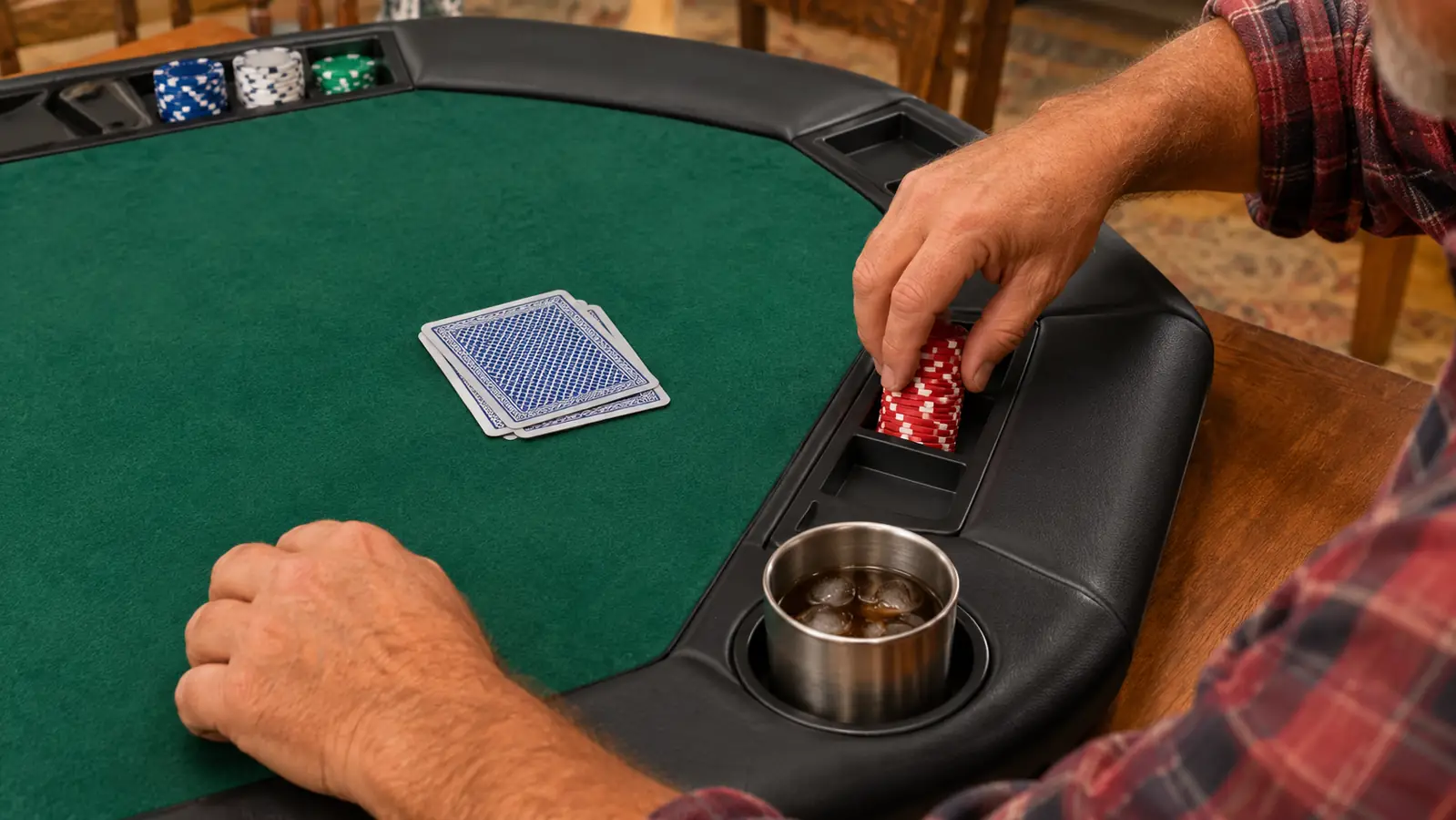
The topper has built-in cup holders and chip trays, and both of them earn their keep. The cup holders are the part I did not expect to care about. Before, bottles sat on the rail of the old table and somebody knocked one over roughly once a month. Now every drink has a hole of its own, and the surface stays dry all night. That sounds like a small thing until you have mopped up a spilled drink in the middle of a hand with the pot sitting there.
The chip trays hold a starting stack so it does not slide into the middle of the table when somebody bumps the edge. I still keep the bank up on the bar behind me in a couple of clear acrylic trays, because counting out a buy-in is easier standing up and it keeps the table clear. Each player gets his stack in front of him in the tray that is cut into the topper, and at the end of the night the chips go straight back into the case.
Cards go in the middle. I deal from a shuffler these days, because Ray's hands stiffen up once the weather turns and shuffling a deck was dragging the game out to a crawl. If you deal by hand, square the deck on the topper, not on the bare table underneath it. That is the whole reason the thing is there, and the surface takes it fine. Wipe it with a dry cloth at the end of the night and it looks the same as the day you unboxed it.
Step 5: Break It Down and Put It Away
When the last hand is over, sweep the chips back into the case, square up the cards, and wipe the topper down with a dry cloth if anybody set a wet glass on it. Then fold it in half. The whole routine takes about two minutes, and it is the reason the table is clear and the room is quiet by the time Diane comes downstairs to say goodnight to whoever is still here.
The zippered bag with handles comes with it, and I actually use the bag. You can carry twenty pounds by the edges, but a four-foot panel is awkward in a doorway and the handles solve that in one step. Folded and bagged, it leans against the wall behind the furnace room door in the basement and stays out of the way until the next Friday. Two years of that and the bag is still holding up, which is more than I can say for the cardboard the chips arrived in.
Do not store it somewhere damp. There is wood under the vinyl, and a basement that smells like a basement is exactly where you do not want a wood panel to sit for six days a week. Mine stays dry and stands upright, and it has stayed flat. If your storage spot gets humid in the summer, find another one. That is a lot easier than replacing the topper two years in.
What Else Helps
The topper fixes the playing surface. It does not fix the rest of the room, and a handful of other things did more for my Friday game than I expected them to. Good plastic cards were the biggest one. Paper decks bend, they pick up moisture off hands, and after a couple of months you can spot the mark on the ace of spades from across the table. Plastic cards wipe clean, they shuffle better, and a set that has been washed with dish soap and dried on a towel still deals true. I keep two decks in rotation so one can be cleaned while the other is in play.
A chip set that does not stick together matters more than people give it credit for. I replaced a cheap plastic set a few years back with a clay composite set in an aluminum case, and the difference in how the chips feel and stack is obvious the first night. The case keeps the denominations sorted, which matters when half the table is not made up of card players, and it keeps the whole bank in one place instead of scattered across the bar.
Light above the table, too. A single bulb in the middle of the ceiling puts your own shadow right across your cards. I hung a shop light directly over the game and it made the whole night easier on the eyes, and nobody has complained about glare since. Chairs are the other one. You want the table edge landing somewhere around your lower ribs when you sit down. Too low and you are reaching up at the felt all night, and your shoulders will tell you about it on Saturday morning.
None of that happens at once. It is a slow upgrade, one piece a year or so, and the topper from Trademark Poker was the one that mattered most because it changed the surface everything else sits on. If you only do one thing this season, do that one. The cards and the chips can wait.
Set it on the table, sit down, deal the first hand
48 inches across, room for eight, and a fold down the middle so it stores against a wall between games. The Trademark Poker topper comes with a zippered bag and handles, and the cup holders and chip trays are built in.
Amazon Check Today's Price on Amazon →