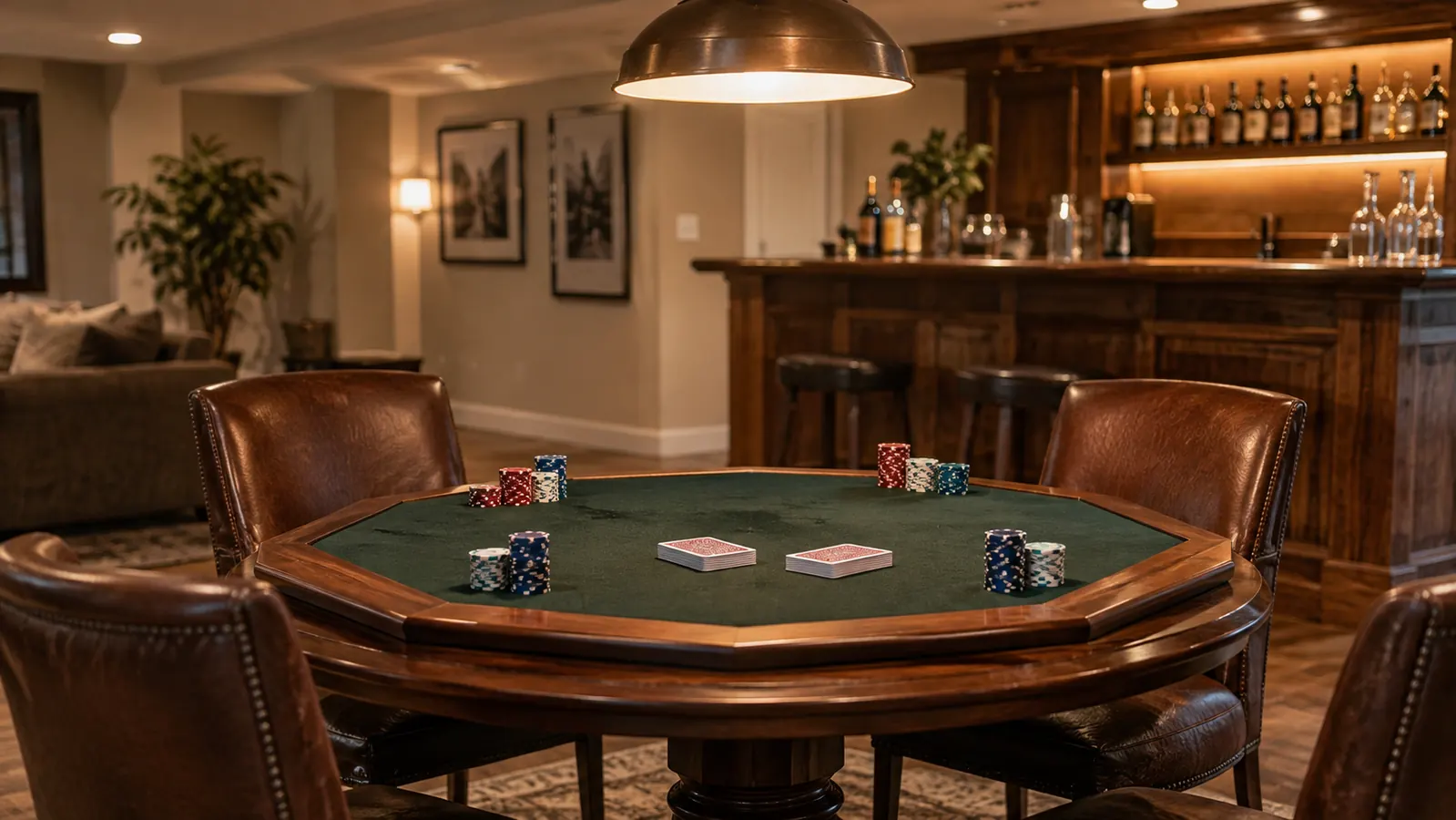
There is no single right answer here, and anyone who has actually hosted a Friday game for a few years will tell you the same. But there is a short answer, and it turns on one question: does the room already have a table in it? If it does, the folding top is the smarter buy. The Trademark Poker 48-inch octagonal topper is what has sat on top of an old four-foot round kitchen table in my basement for the last two years, and it turns that table into a card table in about the time it takes to carry it over from behind the furnace room door. If the room is empty and you want the game to have a permanent home, a full poker table is the better piece of furniture and the better surface to play on. That is the comparison in two paragraphs. The rest of this is the detail behind it.
One thing to get out of the way first: I own the topper, not a full table, so treat the first half of this as a man defending his own purchase. I have played on both. A regular in my game has a full table in his den and I have spent plenty of nights at it, enough to know exactly what I gave up and what I did not. My game is six players, small stakes, in a finished basement with a wood bar and a shelf of chip cases. That is the lens here. If your situation is different, some of this will not apply.
| Folding Table Top (Trademark Poker) | Full Poker Table | |
|---|---|---|
| Cost to get in | A topper costs a fraction of a full table, and you keep the table you already own. | A full table is a piece of furniture and priced like one. |
| Floor space | Takes up none between games. It folds and leans against a wall. | Permanent footprint. The room is a poker room from then on. |
| Storage | Folds in half into a zippered bag with handles, 49 by 2 by 25 inches folded. | Does not store. It lives where it stands. |
| Setup on game night | Unfold, set it on the table, square it up. A minute at most. | Already there. Nothing to set up, ever. |
| Rail and arm comfort | Firm vinyl edge on a wood frame. It does not give. | Padded rail, wide enough to rest a forearm on for hours. |
| Stability | As stable as the table under it, and mine has a little give. | Pedestal base. No shift, no flex, no straightening between hands. |
| Room for eight | Eight seating spots on 48 inches. Eight adults is a negotiation. | Built wide enough that eight seats feel like eight seats. |
| Playing surface | Solid wood under vinyl, cards run true, wipe with a dry cloth. | Deeper surface and usually a proper dealer spot. |
| Taking the game elsewhere | 20.2 pounds in a bag with handles. It fits in a trunk. | You are not moving it without help and a truck. |
| Using the room for something else | Lift it off and the table is a table again. | Nothing else happens on a poker table. |
| Warranty | 30 days against manufacturer defects. | Varies by maker. Often longer, sometimes nothing at all. |
| How long it lasts | Wood frame and vinyl. The hinge and the fold line take the wear. | A solid table outlives most of the furniture in the room. |
Where the Folding Poker Table Top Wins
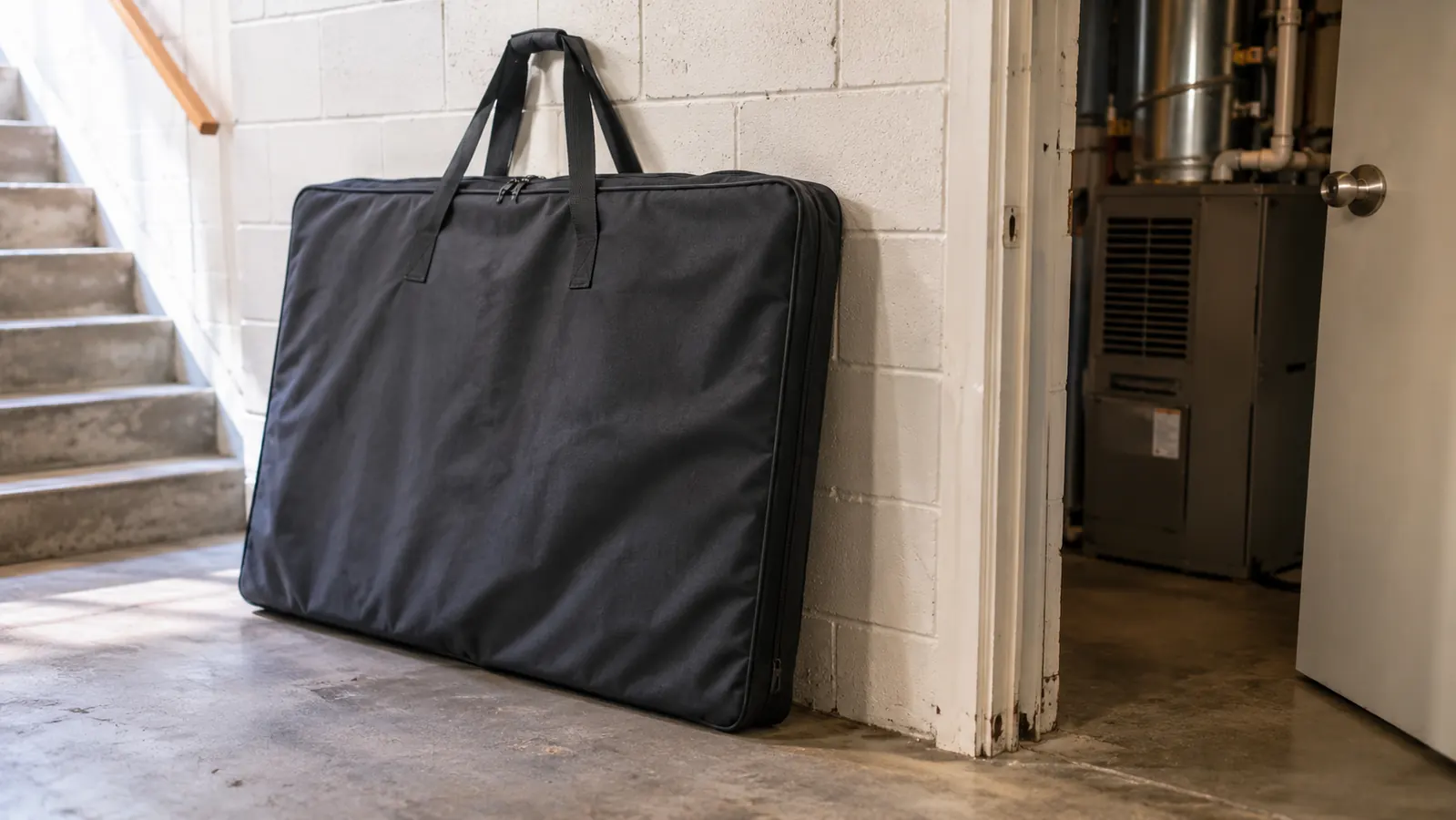
Space is the whole argument, and it is not a small one. My basement is a finished room, not a card room. The Trademark Poker top folds in half, slides into a zippered bag with handles, and stands behind the furnace room door until Friday. Folded it measures 49 by 2 by 25 inches, so it is a thing you own rather than a thing that owns the room. A full table claims its floor permanently. You build the room around it, you vacuum around it, and you stop using that corner for anything else. I have a bar, a shelf, and a door that does not quite latch. I do not have space for a dedicated table, and I would guess most basements do not either.
Before I bought it I tried the free version, like every man does. A half sheet of three-quarter plywood with an old blanket over it, cut to sit on the round table. It worked for one night. After that it lived against the wall looking like scrap, the blanket bunched under the cards every few hands, and there was nowhere to set a glass down that was not the playing surface. The topper does the same job with an edge, cup holders, chip trays and a bag to put it in, and it does not need a staple gun or an apology when company comes over.
Second, it travels, and that matters more than people expect. Twenty point two pounds, a bag with handles, and it goes in the trunk of a car. I have taken mine to my brother-in-law Ray's place twice when his knee was acting up and he did not want to do stairs. Try that with a pedestal table. Third, it comes off. Sunday afternoon the top goes back behind the door and the round table is a table again, which means the room keeps doing two jobs instead of one. A full table does one job and does it well, but it does not stop being a poker table when the game is over. If the space is borrowed, shared, or rented, this is not a close call.
Where the Full Table Wins
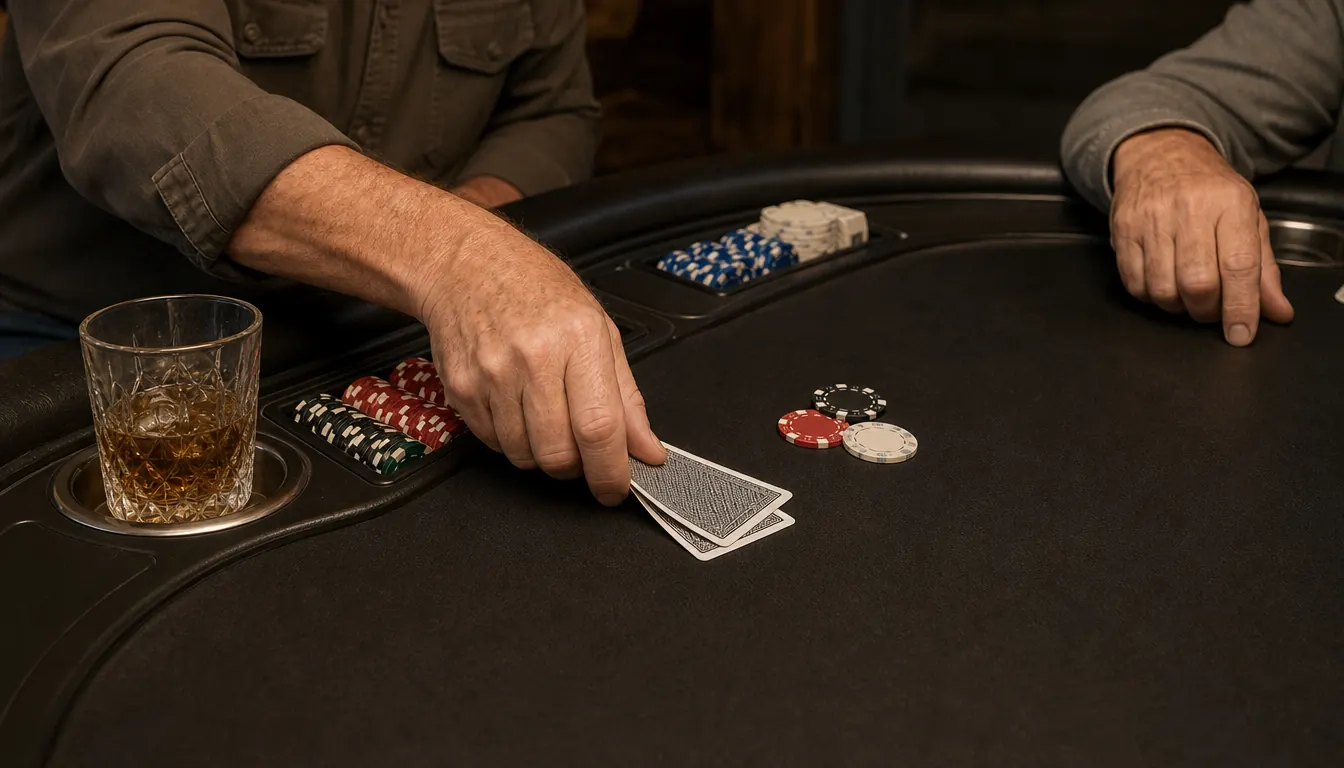
The rail. I will say it plainly, because it is the thing I notice every time I sit down at a real table: a padded rail is worth something. Four hours of leaning your forearms on a firm vinyl edge is a different evening than four hours on a padded rail, and by the last hour your elbows have opinions. The related point is stability. My topper sits on an old round kitchen table, and that table has a little give in it. Lean hard on the far side and you can feel it. A pedestal table does not move. Chips stack cleaner, cards slide cleaner, and nobody squares the table up between hands. Over a long night that steadiness is worth more than it sounds like it should be.
Then there is the honest math on eight players. The Trademark Poker top has settings for eight, and eight people can sit at it. Eight adults cannot sit at it comfortably. A 48-inch octagon puts everybody close, and close means elbows in the chip trays and a dealer reaching around a drink to pitch a card. At six it is a good table. At seven it is fine. At eight it is a negotiation.
I found that out in February, on a night when a seventh and then an eighth body turned up because two of the shop guys had a free evening. We played. Nobody complained out loud. But I spent the last two hours passing drinks over people's shoulders because nobody could reach the rail without standing up, and the chip trays were a hazard by ten o'clock. Now I say six when I send the word out, and if a seventh calls I tell him to bring a folding chair and expect to be patient. A full table is built wide for the number of seats it advertises, and it gives the dealer somewhere to sit that is not the middle of somebody's elbow. On top of that, a solid table outlives the furniture in the room. Wood and a pedestal base last decades. Vinyl on a folding frame lasts as long as the hinge and the fold line do.
Turns the table you already own into a card table in about a minute
48 inches across, eight seating spots, built-in cup holders and chip trays, and it folds in half into a bag with handles when the night is over.
Amazon See the Folding Table Top on Amazon →What Two Years of Friday Nights Taught Me About the Topper
Two years of folding and unfolding every week has not hurt the hinge on mine, which surprised me. What shows wear first is the vinyl at the fold line and along the edge where forearms rest, and that is true of any surface you lean on for years. The play surface itself is solid wood under vinyl, and cards run true across it. No dead spots, no ripple, no place where a card catches. I wipe it with a dry cloth at the end of the night, which is what the maker says to do, and once a month I go over it properly. The cup holders are built into the top at each seat and they do what they say, though a tall glass and a hard lean is a bad idea on any table, mine included.
The first thing I did with it was set it up and take it down five times in a row, because a folding anything is only as good as its hinge and I have been burned before. It did not loosen. What I have noticed since is that the vinyl softens slightly at the fold line, the way a good work glove does after a season, and the wood frame has stayed square. No wobble in the corners yet. If that changes I will say so, but two years of Fridays is a fair test and it has passed it.
The chip trays built into the top are the one place I would push back. They are there, they work, and a starting stack sits in them fine. But they are not deep, and a stack of a hundred chips in a shallow tray gets knocked over by a sleeve sooner or later. I use my clear acrylic trays on top of the surface instead, for the bank and for starting stacks, and let the built-in trays hold odd chips and the spare buttons. If you are the kind of host who likes everything recessed and tidy, that is a small compromise. If you already own trays, you will not care.
Eight seating spots on 48 inches is a real number. Six is what actually fits.
The base table matters more than the topper, and this is the part nobody tells you. Mine is an old four-foot round kitchen table, so the 48-inch top overhangs it by a few inches on every side. That overhang is where the flex comes from when somebody leans. If I had a sturdy square table of the right size under it, the whole setup would feel twice as solid for no extra money. If you are buying the topper and your table wobbles, fix the table first. The top is not the weak point in my setup. The table under it is.
The Setup and Teardown Math
A Friday night here runs like this. I carry the top over from behind the furnace door, unfold it on the round table, and set out the chip trays. The Fat Cat 500-chip set comes off the shelf behind the bar, white for ones, red for fives, blue for tens, green for twenty-fives, black for hundreds. Cards are two double-deck sets of Copag, so one deck is in play and one is shuffled and waiting. The shuffler sits next to whoever is dealing, which lately is Ray, because his hands stiffen up and the machine keeps the game moving. All of that is done in under ten minutes, and most of it is the chips, not the table.
I have timed it, because I am the kind of man who times things. Six minutes for the table and the chairs, four for the chips out of the case and into trays, two for the cards and the shuffler. The chairs are the slow part, because four of them live in the utility room and have to come down the hall two at a time. The topper itself is the fastest thing in the whole routine. Unfold, set it down, push the corners square, done.
Teardown is the same in reverse, and it is the part that decides whether you host weekly or once a season. Chips back in the case, cards squared, top folded, bagged, and back behind the door. Ten minutes, maybe twelve if somebody spilled something. For nine years I have been upgrading this basement piece by piece, and the topper is the piece that made a weekly game realistic, because before it I was dealing on a bare table with a towel under the cards. In the summer the game drops to every other week, because Lake Erie has walleye in it and I have a boat. The topper does not care either way.
Who Should Buy Which
Buy the folding top if the room already has a table in it, if the room does double duty, if you rent, if the game moves around, or if you want to be playing this Friday instead of assembling furniture all weekend. Buy it if your game is six players and a couple of beers, which is most games. Buy it if you want the option to lift it off on Sunday and forget poker exists until next week. At the current price it is the low-risk way into a decent playing surface, and if you hate it you have lost an evening and a little shelf space rather than a corner of your basement.
Buy the full table if the room is already spoken for, meaning you have the floor and nobody needs it for anything else. Buy it if your game runs eight and you actually seat eight, or if the night goes long and forearms matter, or if you want the thing to feel like a card room and not like a kitchen table with a cover on it. Buy it if you are done moving furniture and you want to walk downstairs and have the table be there. That is a real pleasure and I am not going to pretend otherwise. It is also a bigger commitment in money, in floor, and in the next time you paint that room.
If the room already has a table, you already have your answer
The 48-inch folding octagon: eight seating spots, built-in cup holders and chip trays, 20.2 pounds, and it stores in a bag behind a door. Reviewers have been using this one for years.
Amazon See the Folding Table Top on Amazon →