

The first Friday I ever hosted, I set the chips out the way I do most things, which is to say I did not think about it. I dumped a plastic 300-chip set on the table, told five friends to grab a stack, and then spent the next three hours answering the same question. What is a blue one worth? Nobody knew. Including me.
That was nine years ago and a different set. The lesson stuck. Denominations are not a detail you handle on the fly at seven o'clock on a Friday. They are the thing that decides whether a game runs smooth or turns into a rolling argument about making change. These days I set out a 500-chip Fat Cat Claytec set from the aluminum case behind the basement bar, six players most Fridays, and setup takes about fifteen minutes because the values were decided years ago and have not moved since.
Five colors, five values, and the buttons already in the case
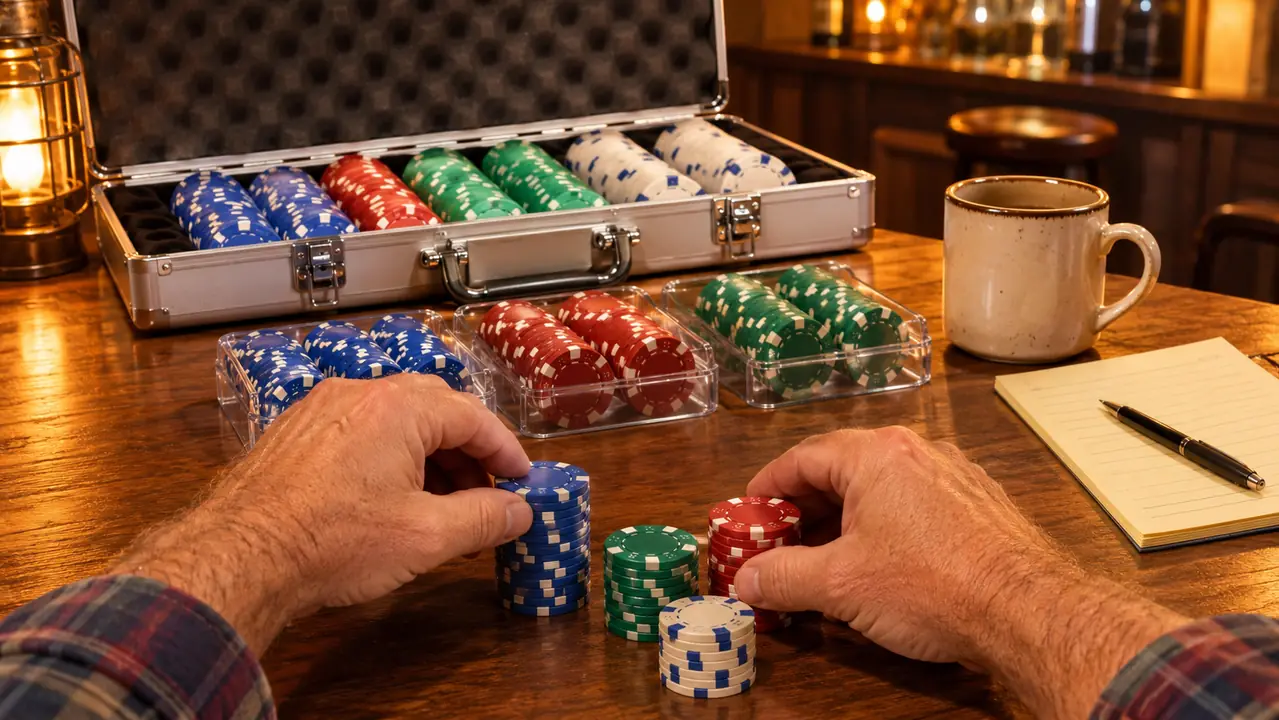
The 11.5g Claytec chips in this set give you a clean ladder to work from, and the big blind, small blind and dealer buttons come with it. Five hundred chips is enough for six players and a real bank behind them.
Amazon Check Today's Price on Amazon →Why the Values Matter More Than the Chips
I have played in games with nice chips and bad values, and games with cheap chips and good values. The second kind is always the better night. A chip is only a marker. What makes the game work is that every player at the table knows, without asking, what each marker is worth and how to make change out of it. Get that right and a modest set plays beautifully. Get it wrong and the nicest set in the world still stalls out every fourth hand.
So here is the whole method, in the order I actually do it. Five steps, and the first four happen before anybody walks down the stairs. The fifth happens twice, once at the break and once after the last hand. None of it is complicated. All of it is worth writing down once so you never have to work it out again.
Five Steps I Run Through Before the First Hand
Step 1: Pick One Chip to Be the Base Unit
Every set needs one chip that means one. Not two, not twenty five. One. Mine is the white chip, and it has been the white chip since the day I bought the set. Everything else in the case is a multiple of it and reads off it.
The reason is simple. When your smallest chip is one, your blinds are whole numbers. Blinds of one and two. Blinds of two and five. Nobody at the table has to do arithmetic to post, and nobody has to break a chip to post. The moment your base unit is something awkward, you are making change on the first hand of the night, and you will still be making change at eleven.
I tried it the other way once, years back, using the green as the base and calling it one. It lasted exactly one night. Half the table kept converting back to the old values in their heads, somebody posted a blind with the wrong chip twice in a row, and by the end of the evening nobody was sure what anything was worth. The base unit is not a thing to get creative with. One chip, one unit, no exceptions.
Pick it before you pick anything else, because it anchors everything above it. And once you have picked it, do not change it mid-game. If you change the ladder halfway through a night, half the table plays the old values and half plays the new ones, and the pot gets sorted out by argument.
Step 2: Space the Colors Two to Four Times Apart
Here is the ladder I use. White is one. Red is five. Blue is ten. Green is twenty five. Black is one hundred. Five colors, five values, and the gap between any two neighboring colors lands somewhere between two and four times.
There are two ways to get this wrong, and I have watched people find both. The first is spacing the colors too far apart, something like one, ten, one hundred. It looks tidy on paper. In practice nobody can make change. The jump from one to ten means counting out nine chips to break a ten, and the jump from ten to a hundred means counting out ninety.
The second way is spacing them too close, like one, two, three, four, five. Now you have five colors doing the work of two, the whole table spends the night sorting singles, and every starting stack turns into a tower that goes over the first time somebody reaches for their drink. You also burn through your low chips in an hour and end up with a bank nobody can break.
Two to four times is the range where counting stays easy and change stays possible. Once I settled on the ladder, I wrote it on a three by five card in marker and dropped the card in the case. When a new guy sits down, I point at the card instead of explaining. In three years with this set, I have not had to say what a blue chip is worth more than once in an evening.
Step 3: Build Starting Stacks Before Anybody Sits Down
This is the part people skip, and it is the part that saves the most time. I build every starting stack before the first guy comes down the stairs. Two of the clear acrylic trays hold six stacks, one per seat, and I set them on the bar so people can pick one up and sit down.
The stack I have used since the Fat Cat set came home is this. Twenty whites worth twenty. Ten reds worth fifty. Five blues worth fifty. Two greens worth fifty. One black worth one hundred. That is thirty eight chips and two hundred seventy in value, and building six of them takes me about four minutes once the trays are out.
The black chip is in there on purpose. If I left it in the bank, players would spend the first hour building piles of blue and never learn the top of the ladder. Handing them one black chip at the start teaches the value without a speech, and it keeps the stack shorter, which keeps it standing. If two hundred seventy plays too deep for your crowd, drop the black and the stack becomes a hundred seventy. Nothing else has to change.
Fewer chips per player is usually better than more. A stack of forty reads at a glance. A stack of eighty gets knocked over, miscounted, and half sorted into piles that never get merged back. Six players at thirty eight chips each also leaves you a real bank, which matters more than a fat starting stack.
Thirty eight chips and two hundred seventy in value, six times over, laid out before anybody walks down the stairs. The setup takes four minutes and the arguing takes none.
Step 4: Count the Bank and Settle the Rebuy Rule Before the First Hand
Whatever is left in the case after the starting stacks is your bank. Count it before the first hand, not the whole set, just the remainder, and write the number on the pad. This takes two minutes and it is the only way you will know at midnight whether the chips still add up.
Six starting stacks pull two hundred twenty eight chips out of a five hundred chip Fat Cat set. That leaves a little over half the set in the case, which is plenty for rebuys and for coloring up at the break. If your game runs eight, thin the starting stacks a touch, or count on closing rebuys earlier than you would with six.
Then settle the rebuy rule out loud, before anybody is stuck. Mine is simple. A player who goes broke buys the same stack, same composition, and I mark it on the pad. Nobody buys chips off another player at the table. Nobody plays on credit. That rule has caused exactly zero arguments in nine years, which is more than I can say for most rules I have tried.
The pad settles the end of the night too. When we cash out, the chip counts on the pad should match what is on the table plus what is still in the bank. It usually does. When it does not, it is almost always a green that got dropped into the wrong tray, not a thief.
Step 5: Color Up at the Break and Reset at the End of the Night
Somewhere past the halfway point, the white chips become a nuisance. There are too many of them on the table and every stack looks like a stack of dimes. That is when I color up. Players hand me their whites, I hand back reds, and the table gets cleaner in about thirty seconds.
The easy way to handle the leftover whites that do not make a full red is to let whoever has the most of them take the pile for one red chip. It is not perfectly fair in value to whoever loses the cut, and it is close enough that nobody in nine years has cared. If two players are close, I cut a card for it. I say out loud that it is a house rule and not a rule of poker, and then I do it anyway.
At the end of the night, the reset matters more than the setup, and it is the step everybody skips. I sort every color back into the trays, count the bank against the number I wrote down before the game, and put the card back in the Fat Cat case. Chips that go back sorted come out sorted. Chips that get dumped in loose come out as a forty minute job the following Friday, and that job always lands on the host.
What Else Helps
The chips are the center of it, but a few other pieces make the setup hold. The buttons that came in the case do more work than people expect. Big blind, small blind, dealer. When the dealer button moves and the blinds follow it, nobody has to remember who posted last, and the argument about whose turn it is disappears before it starts.
The card trays earn their keep too. Ten of them, and I use most. Two hold the bank on the bar between games so I can see the whole reserve at a glance. The rest hold starting stacks. Since I started using them, I have not once had a player count out his own stack at the table while five other people waited on him.
Two decks in rotation help as well. My set came with two, and I have been through a few replacement decks since then. Having a shuffled second deck ready means the deal moves the second the hand ends instead of stopping while somebody shuffles. Tom's hands are fine. Ray's are not, which is why an automatic shuffler sits next to the dealer now. That one purchase did more for the pace of the game than anything except the chips themselves.
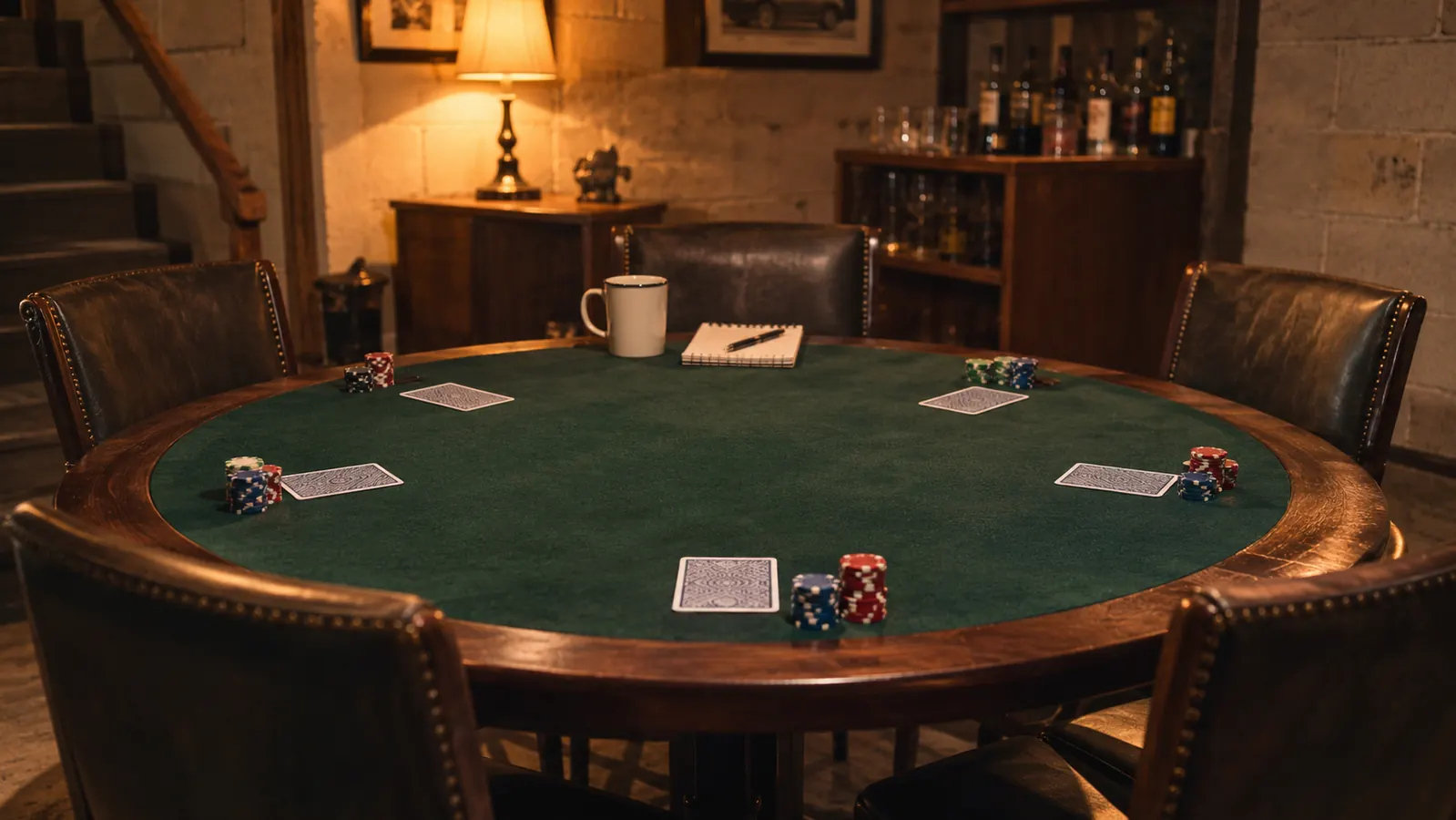
The playing surface matters less than you think, but it helps. My game sits on a folding octagon top with cup holders, and the cup holders alone have saved more hands than any rule I have written down. A drink set on a bare table finds a card eventually. Give it a hole to sit in and the problem goes away.
One more thing. Keep the whole setup in one place. My case lives on the shelf behind the bar, the trays stack beside it, and the three by five card is inside the case. When everything lives together, setup is opening a case. When it does not, setup is a hunt through a basement for a missing stack of greens, and the game starts late.
The set my Friday game has run on for three years
Five hundred 11.5g Claytec chips in an aluminum case, with the blind and dealer buttons and two decks of cards included. Pick a base unit, space the colors, write the ladder on a card, and you are set up in fifteen minutes.
Amazon Check Today's Price on Amazon →