

Three years ago I bought the Fat Cat 500 chip set for one dumb reason: my old plastic chips had welded themselves into a single brick in the closet, and I was tired of prying them apart with a butter knife before every Friday game. That was the whole research process. I wanted chips that came apart when I opened the case.
Three years, somewhere around 140 game nights, and six regulars later, I have a more informed opinion. Some of it is good. Some of it is the reason I nearly wrote this up after the first month and then decided to wait until the shine wore off. The short version: the Fat Cat chips are the best thing in the case, and the case is the worst thing in the case. The longer version is below, and I have tried to be as honest about the parts that annoy me as about the parts that work.
The Quick Verdict
The chips stack, sound and hold up like a much more expensive set. The aluminum case is the weak link and the included cards are a formality. Buy it for the chips.
Amazon Check Today's Price →Three years of Friday nights and the chips are still the best part of this set.
500 striped Claytec chips at 11.5 grams, the blind and dealer buttons, two decks of cards and an aluminum carrying case. The chips earn their keep. Check today's price and decide whether the case bothers you half as much as it bothers me.
Amazon Check Today's Price on Amazon →What Comes in the Case, and What It Is Made Of
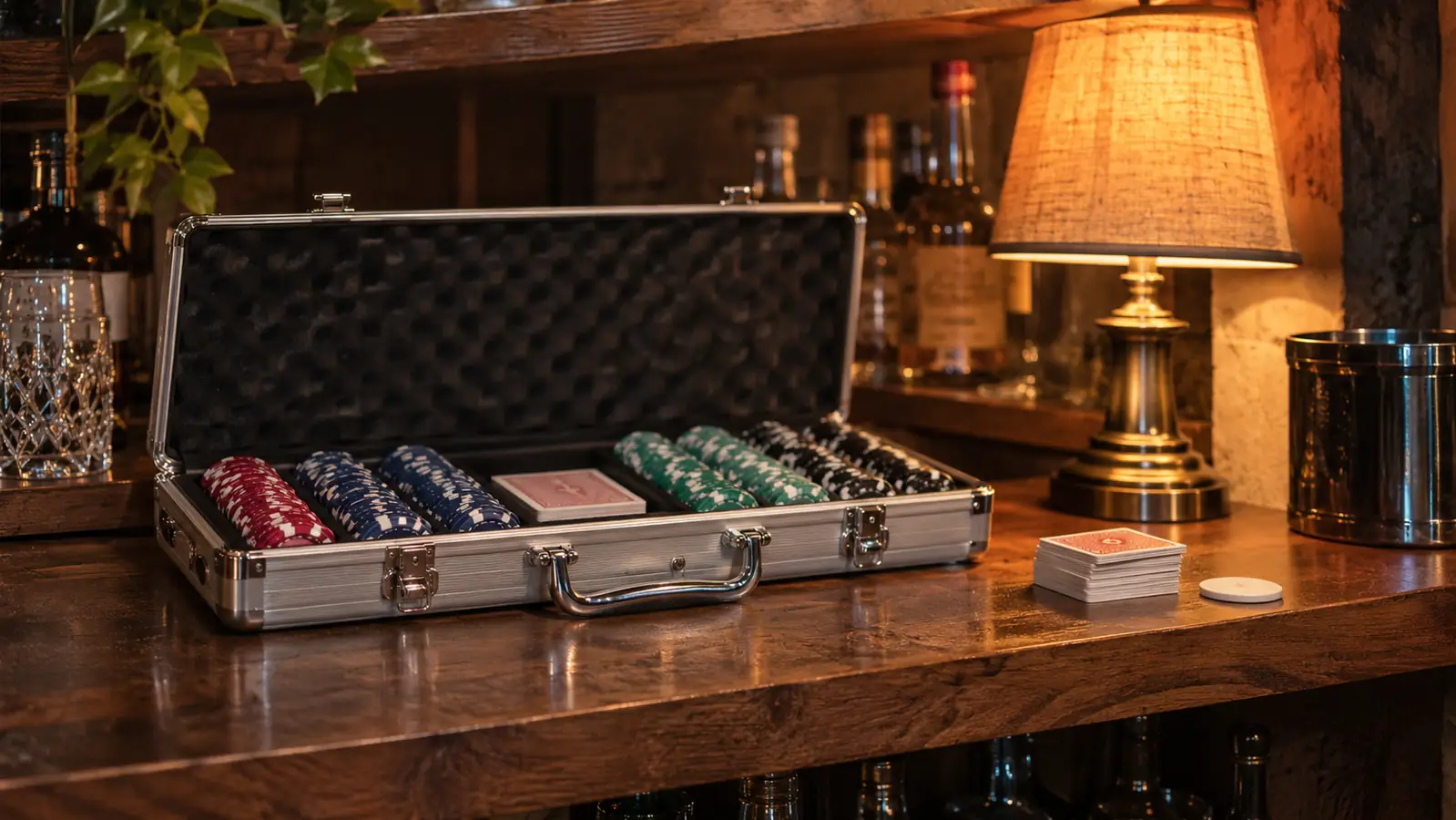
The listing says 500 chips and that is exactly what shows up. Five hundred striped Claytec chips at 11.5 grams apiece, a full set of Texas Hold'em buttons with big blind, little blind and dealer, two decks of playing cards, and an aluminum carrying case. The manufacturer lists it for 2 to 8 players and recommends 14 years and up, which is worth knowing if you have kids who wander down to the basement while the game is going.
Claytec is Fat Cat's name for a clay composite, not real clay. Genuine clay chips in this count would be a different purchase entirely, and you would know it the moment you looked at the total. What the composite gets you is a chip with actual texture on the face, stripes molded into the edge, and enough weight that it does not feel like a piece from a board game. It is a compound, and it behaves like one, which I mean as a compliment.
Here is what I would tell a friend standing in my basement holding one of these chips. The chips are the product. The buttons and cards are a bonus. The case is packaging that happens to be reusable. I have owned sets where it was the other way around, where the box was nicer than what came out of it. This one is not that.

How I've Used It
The set lives on the shelf behind my basement bar and comes down every Friday night for a six-player game with stakes small enough that nobody at the table is fooling himself. My brother-in-law Ray, my neighbor Tom, and three fellows from the shop I retired out of. Nine years of hosting, three of them with this set in the middle of it.
I bank five denominations: ones, fives, tens, twenty-fives and hundreds. That covers a starting stack for six players with room to top up, and I have never once had to say we are out of the small ones the way I did with my old 300-chip set. That was the real upgrade, if I am honest. Not the material and not the weight. The count.
The chips get handled hard. Stacked, knocked over, slid across the table, dropped on a concrete floor more than once by Tom, who has hands like a catcher's mitt and no apparent nervous system. Three years in, I have not had a single chip crack or lose an edge. The plastic ones would show a nick if you looked at them wrong, and after a few summers in a closet they stuck together so badly you could have used them as a doorstop.
The first real test came in the winter of that first year. Ray caught a full cup of coffee with his elbow in the middle of a hand, and about forty chips on his side of the table went into the shallow end of it. We blotted them with paper towels, spread them out across the bar to dry overnight, and by the next Friday they were back in the case and stacking the same as ever. No swelling, no soft edges, no stain I could find the next morning. My old plastic set would have come out of that spill with a tacky film that never washed off, and I would have been picking lint off them for a month.
The case has been opened and closed on that shelf more times than I could guess, and the chips have gone back in every single time. That sounds like a low bar. It is not, when you consider how often the last set ended up loose in a shoebox because the case fell apart first.
Roughly 140 Friday nights, six players a night, and not one cracked chip. I cannot say the same for the case.
Where the Set Earns Its Keep
Weight is the first thing people ask about, so let me get it out of the way. 11.5 grams per chip is lighter than the 14-gram chips you will find in a card room, and if you have played with those, the difference is noticeable for the first ten minutes of the night. Then it stops mattering, because you are not comparing chips anymore, you are playing poker with your brother-in-law and losing to him on a river card.
What does matter is how they stack and how they sound. A column of these goes together clean and stays together when somebody bumps the table reaching for a drink. They make a solid click instead of the hollow clack my plastic set made. If you have only ever played with cheap chips, that noise will surprise you the first night. It is the difference between a tool and a toy.
First night with them, Tom picked one up, bounced it in his palm and said it felt like a piece from a good board game. I took that as an insult until he explained he meant it the other way, that it had some heft and a finish instead of a seam down the middle. Six hands later he had stopped talking about it entirely. That is the pattern with this set. The things you notice in the first hour are not the things you are still thinking about in the third year, and what is left after the newness wears off is a stack of chips that does its job without asking for attention.
The striped edges do real work too. When there are six stacks in front of you and somebody pushes in a bet, you can read the denomination across the table without picking anything up or asking a stupid question. Sounds like a small thing. It stops being small about the third hand of the night, when the game gets quick and nobody wants to pause so you can squint at a chip.
And the thing I did not expect: they hold a stack on felt. The old plastic chips would slide if you looked at them, which meant every pot had to be built carefully or it went over. These sit down and stay down. It is the sort of detail you only notice after it stops annoying you.
What I Liked
- 500 chips is enough bank for a six- to eight-player game across five denominations, with no shortages
- Claytec composite has real texture and a solid click, nothing like the plastic set it replaced
- Three years of weekly play and not one cracked or chipped chip
- Blind and dealer buttons plus two decks of cards come in the case
- Portable aluminum case keeps the whole set in one place on a shelf
Where It Falls Short
- 11.5 grams per chip is light next to casino-weight chips
- The aluminum case is the weakest part of the set, and after three years the lid no longer sits square
- The two included decks are paper cards and I stopped using them inside a month
- Chips work their way into the gaps between the case trays when you carry it
- No chip trays or racks come with it, so my bank trays were bought separately
What I Would Change
Start with the case, because that is where my patience has worn thinnest. It is a thin aluminum carrying case, light enough to move from the shelf to the table in one hand, and it did its job fine for the first year. Somewhere around year two the lid stopped sitting square. Now it closes, but it closes with a shrug, and I have learned to set it down flat instead of dropping it on the table like I used to.
The interior is the other half of that complaint. The trays inside shift when you carry the case, and small chips work their way into the gaps, so opening it sounds like a box of loose change instead of a chip set. It does not damage anything. It just means the first two minutes of setup every Friday are spent sorting the ones back into the right tray, and I have been doing that for about two years now.
I tried to fix the rattle the cheap way first. I cut a strip of the foam that came packed around a television and laid it across the top tray, figuring it would take up the slack and hold everything still. That worked for about a month. Then the foam compressed down to a flat nothing and the chips were loose again, and it started shedding little crumbs into the case, which was worse than the noise. The next spring I tried two rubber bands around the outside to hold the lid tight. That worked, technically, but it turned opening the case into a two-hand job, and I got tired of fiddling with it in the middle of setting up. Now I carry it flat, set it down easy, and accept the noise.
The two decks that come in the case are paper. If you play once a month they will serve. If you host weekly, they will bend, soften and pick up whatever is on the table within a couple of months, which is exactly why I moved to plastic cards and never looked back. That is not a defect in the set so much as a mismatch between what comes free and how a regular game actually runs. Treat the included cards as a starter and budget for better ones.
I wish Fat Cat made a 14-gram version of this same chip in this same count. 11.5 grams is fine. I have stopped noticing it. But fine is the honest word, and if you came up playing in a card room, you will notice the lightness every time you build a stack for the first few weeks. There is a tradeoff in there, though. A heavier chip means a heavier case, and the case is already the part I do not trust, so maybe the lighter chip is the right call and I am just stubborn.
The chips have held up better than anything else in the case, and the case has held up better than my patience.
The Tradeoffs Nobody Mentions
Nobody tells you that a clay composite chip picks up a chalky film. Mine do, especially the denominations that sit in the case longest without being dealt. A wipe with a damp cloth takes it right off. Do that once a year and the set looks close to new. Skip it for three years the way I did and you will wonder what you have been handling.
Nobody tells you that 500 chips is more than it sounds like. In the case it is a manageable box on a shelf. On the table, with six starting stacks and a bank, it takes up real estate. I run a folding octagon top on an old kitchen table, and my bank trays take up a full corner of it. If your table is small, that is something to plan around before you set the thing down and find out.
And nobody tells you that the buttons are the piece you will touch every single hand. The dealer button goes around the table all night and the blinds get called out constantly. It sounds like a trivial extra until you play one game without them, which I did years ago with a set that had none, and then you understand why every listing mentions them.
The paperwork in the case lists a 30 day warranty from Fat Cat against manufacturer defects, which is honest if unglamorous. It tells you they expect anything that fails to fail early. Mine is well past that window and still fine, so the warranty never came into it for me. But if a chip shows up cracked or the case arrives with a lid that does not sit right, that first month is the whole window you have, and it is worth opening the box and counting everything before it closes.
Who This Is For
You host a regular game with five to eight people, the stakes are small enough that nobody is going to lose a paycheck, and the whole point is sitting in a basement arguing about baseball while the cards come around. You want a real bank of chips, you want them to feel like something in the hand, and you do not want to think about the purchase again for five years. That is who this set was built for and that is who it has served in my basement.
It also suits the person upgrading from a plastic set with a cracked lid and chips that stick together, which is exactly the hole I was standing in three years ago. Going from plastic to a clay composite at 11.5 grams is the biggest jump you will make. Going from this to true clay is a much smaller step than the one you took to get here, and worth knowing before you talk yourself into spending a lot more.
One more group: the host who is tired of scrounging change. Half the reason I bought a 500-chip set was that our old game kept stopping so somebody could raid a jar for singles. A real bank of five denominations ends that permanently, and that alone was worth the shelf space.
Who Should Skip It
If you play with people who own real clay chips and talk about them the way other people talk about golf clubs, this set will not impress them and you will hear about the weight before the first hand is dealt. Skip it, save up, and buy heavier. Same if you are running a ten-player tournament where 500 chips gets tight in a hurry. You want more count than this, not nicer chips.
And if the case matters to you as much as the chips do, look elsewhere or plan on replacing it. The listing calls this portable and travel sized, and it is portable in the sense that a person can carry it across a room. It is not a case I would hand to an airline, and mine has not left the basement in three years, which is exactly how I like it. Buy the chips for the chips and keep the case on a shelf.
If the chips matter more to you than the case, this is the set.
500 striped Claytec chips at 11.5 grams, blind and dealer buttons, two decks of cards and an aluminum carrying case, three years proven on my own table with six players every Friday. Check today's price and see whether the chips do enough to make you forgive the rest.
Amazon Check Today's Price on Amazon →