
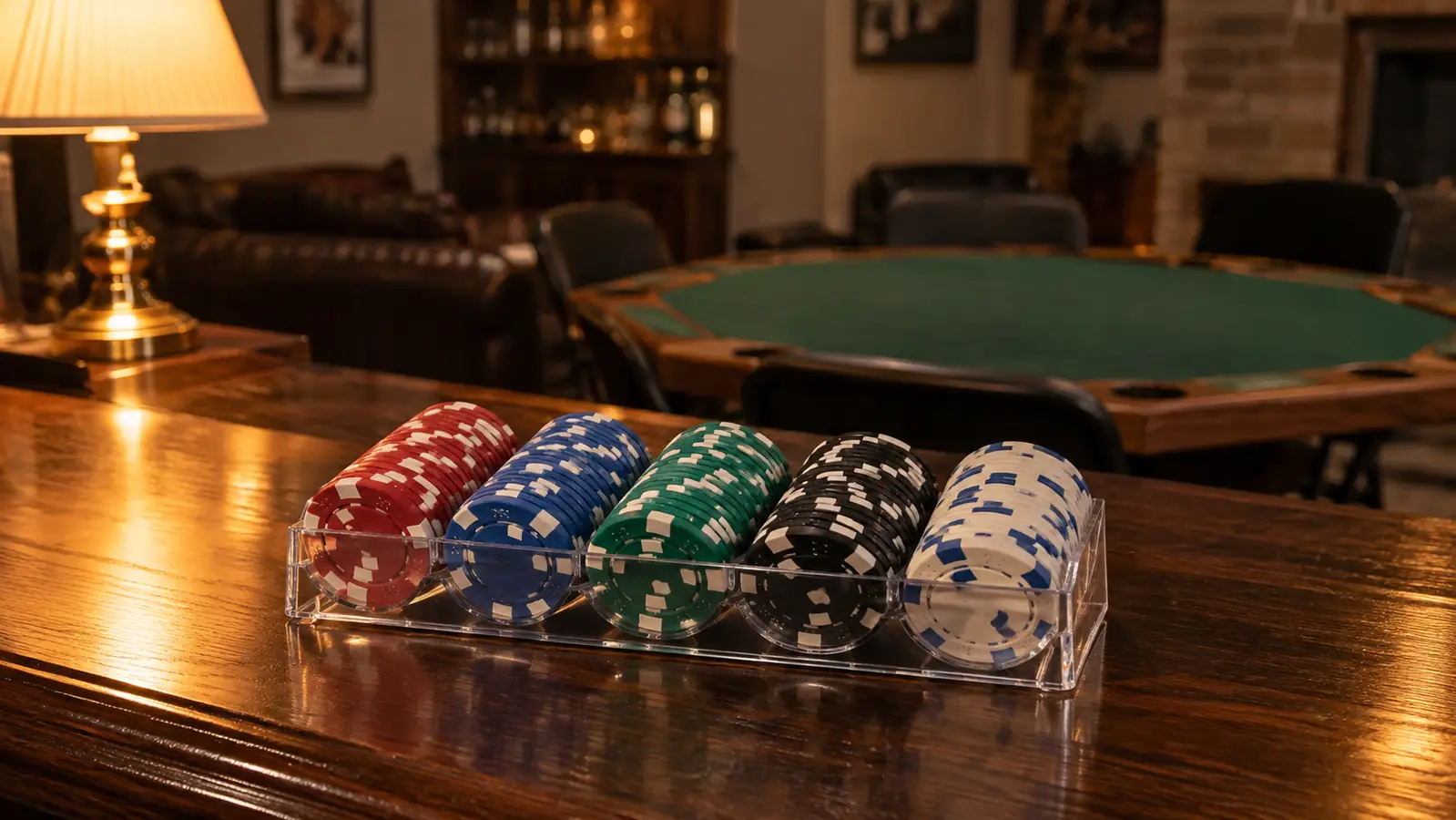
Nine years of hosting Friday night poker in my basement, and the piece of equipment that failed first was never the table or the cards. It was whatever was holding the chips. I started with a cheap plastic set that came in a molded tray, and when the chips went sticky and I replaced them, the trays went out with them. After that it was ziplock bags, then a shoebox, then a loose stack on the bar that my brother-in-law Ray knocked over twice in one night. About a year ago I bought a pack of ten Brybelly clear acrylic chip trays and stopped thinking about the problem. That is the highest compliment I can pay a piece of gear.
Here is what they are, plainly. Ten clear acrylic trays from Brybelly, each holding 100 standard-size chips, sold without chips. A single tray measures 7.825 inches long, 2.7 inches wide and 0.625 inches deep. The whole pack of ten weighs 1.7 pounds empty. They are the least interesting thing in my game room, and after a year they are also the thing I have had to think about least. This is a long-term report rather than a first-impression one. I have run roughly forty game nights through these trays, plus the summer stretch when the game drops to every other week because I am up on Lake Erie chasing walleye.
The Quick Verdict
Ten clear acrylic trays that hold 100 chips each, sit flat on a bar, and came through a year of Friday nights without a crack. They show every fingerprint and all the basement dust, and a loaded tray is not something you carry across a room. Buy them for the bank, not for looks.
Amazon Check Today's Price →Ten trays, a thousand chips of bank capacity, and no more counting change off the felt
If your chips live in bags, a shoebox, or a case you have to open every time somebody wants change, this is the fix. Ten clear acrylic trays, 100 chips each, so you can see what you are reaching for without lifting anything.
Amazon See Today's Price on Amazon →How I've Used Them
My game is six guys in the finished basement, usually the same six. Ray is my brother-in-law, Tom is the neighbor, and the rest are fellas I worked with at the shop before I retired. We play small stakes for the fun of it, and the game moves slow because most of the talking happens between hands. That matters for a chip tray, because the tray sits out in the open for four hours while people lean on the bar and set drinks down next to it. A tray that tips or spills is worse than no tray at all, and after nine years I have spilled my share.
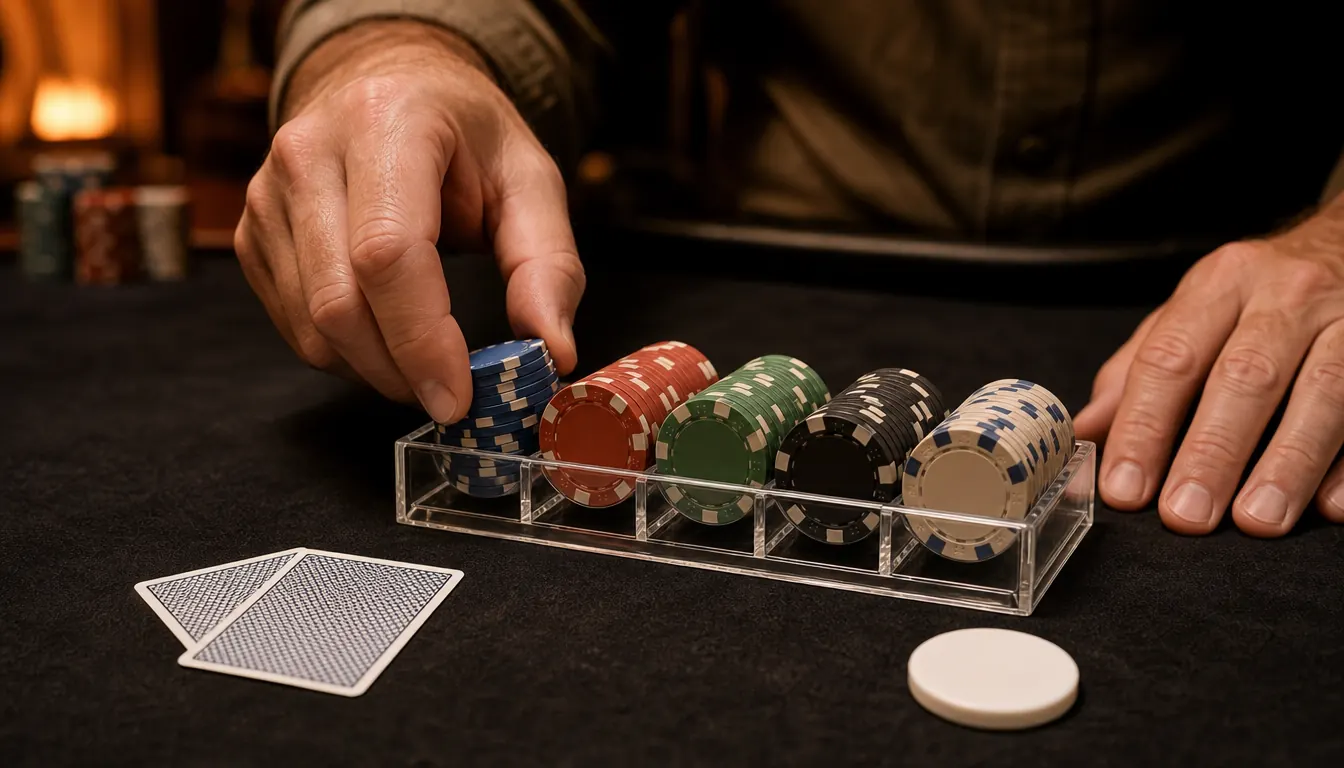
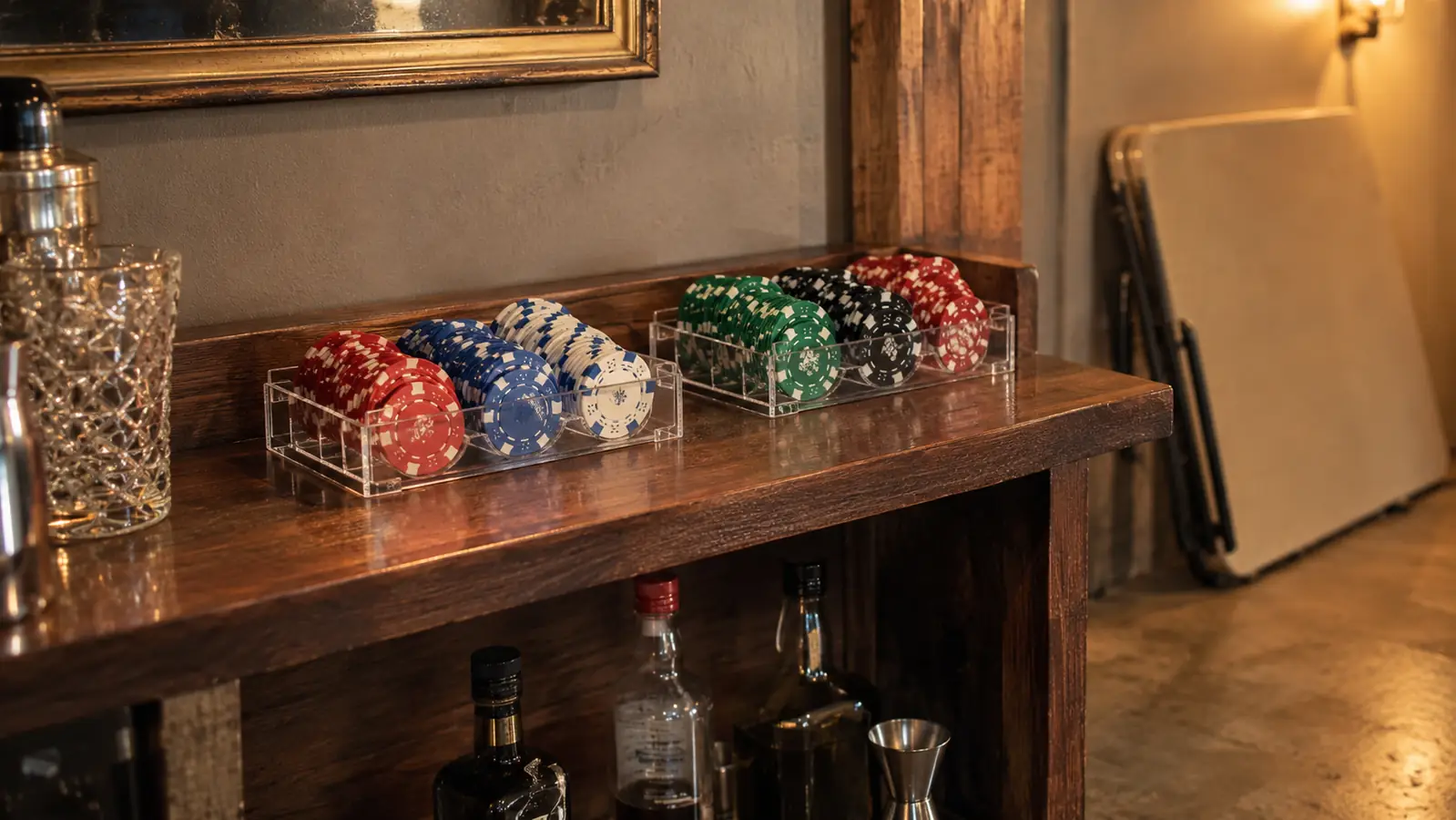
Two of the ten Brybelly trays hold the bank. That is the working money for the night, sitting on the bar within reach of the table. I sort by denomination: white for 1, red for 5, blue for 10, green for 25, black for 100. Two trays at a hundred chips each gives me a two hundred chip bank, which is more than this game has ever needed in one evening. When somebody wants change, they reach over and pinch what they need instead of me counting it out hand to hand. That sounds like a small thing until you have done it the other way for a few years and lost count of how many times you have been interrupted mid-sentence to break a chip.
The other eight trays come out when I set up. I build six starting stacks before anyone arrives, one tray per player, and set each tray at a seat on the table top. Nobody gets shorted and nobody argues about it, because the whole stack is laid out where they can see it. When the night ends, the trays go back on the bar and the leftovers go into the gap in my Fat Cat aluminum case, which has carried the same 500-chip Claytec set for about three years now. The empties stack in the same gap. Nothing has gone missing in a year, which for this basement is close to a record.
I should say what the rest of the room looks like, because a tray only works if it works with what you already own. The table is a 48-inch folding octagon top with eight seats, black felt, that I set on an old four-foot round kitchen table. When the night is done it folds in half and leans against the wall behind the furnace room door. Cards are Copag 1546 plastic, two double-deck sets in rotation, and the newest thing in the room is a KPAW shuffler I bought about five months back because Ray's hands stiffen up with arthritis and shuffling was slowing the game to a crawl. The trays fit that room without asking anything of it.
A Year of Friday Nights, and What Actually Broke
Nothing cracked. I want to lead with that because thin acrylic is the kind of thing that either survives or it does not, and these Brybelly trays survived. My basement floor is painted concrete, which is not a forgiving surface. A loaded tray has gone off the bar twice, once because Tom gestured at something and caught it with his elbow, and once because I set one too close to the edge while I was arguing about a call. Both times the chips went everywhere. Both times the tray landed corner-first and both times I picked it up expecting a split. There is a scuff at one corner, and that is the entire damage report.
I clean them about twice a year with a damp rag and a drop of dish soap, same as I do the cards, and I dry them right away because I do not want water spots setting on anything clear. Fine scratches have shown up, the kind you get from chips sliding in and out a few hundred times a night. You have to hold one up to the light to see them. They are not visible from a seat at the table, and I have looked. If you are the sort of person who needs the gear to look new forever, clear acrylic will disappoint you, and it will disappoint you faster than any other material I have used in this room.
What surprised me is how little they have softened. The walls of the tray have some give to them, more than I expected from something this thin, and there is no sag in the middle after a year of loaded trays sitting on a shelf behind the bar. The edges have stayed square, which is the part I watched closest, because a corner that rounds off is the first sign a tray is done. I had one tray spend a whole summer on the bar with chips in it and no cover, through the humid months, and it wiped clean and sat flat on the counter afterward.
The one thing that has changed is the sound. New trays have a bright click when you drop chips into them. A year in, that click is a little duller, the way a good tool gets quieter with use. Nothing about it bothers me. It is the sort of detail you only notice because you handle the same object every week for a year, and it is the only sign so far that these are not brand new.
The Numbers That Actually Matter
0.625 inches deep is the number I would look at first if I were buying again. That depth means a full tray of chips still sits proud of the rim, which is what lets you pinch a stack out one-handed without dumping the rest. Trays that are deeper than they need to be force you to dig, and digging is how you knock a neighbor's stack over. The 2.7 inch width sits comfortably on the rail of my bar and on the edge of the folding table top, and 7.825 inches of length is short enough that two trays sit side by side without crowding the spot where I am not supposed to set my drink. These are not glamorous measurements, but they are the ones that decide whether a tray is annoying or invisible during a game.
A tray holds 100 chips. Ten trays hold a thousand, which is how Brybelly sells them and part of why the pack is worth buying even if your set is smaller than mine. My set is 500 chips, so in practice I am running at half capacity, and the extra trays are doing starting-stack duty on game night. If you run a bigger set, or you host a two-table night, the math still works in your favor. The trays are built for standard-size chips, which is what the Fat Cat Claytec chips are, and they fit with a little room to spare rather than tight enough that you have to press them down. I would not force anything thicker into them, and I would not buy these for a novelty set with oversized chips.
The last number is 1.7 pounds, which is the shipping weight of the whole pack. That tells you these are light. Light is good when you are moving the bank from the shelf to the bar in one trip. Light is also the reason I would not carry a loaded tray across the room, and there is more on that below. For the job they are built for, sitting still while people take chips out of them, light is exactly right.
Where They Come Up Short
No lid. No latch. No lock. A tray full of chips is a tray you carry with two hands and your eyes on it, or a tray you do not carry at all. That is the single biggest limitation and I want it stated plainly, because I have read complaints from people who expected trays like these to travel. They do not travel. They hold chips in one place and they hold them well, and if you need to move chips to somebody else's house, that is a case and not a tray.
Clear acrylic is honest to a fault. Every fingerprint shows, and my basement is a basement, so dust settles on everything that sits still for a week. The trays on the bar get a wipe before company arrives if I want them looking sharp, and after a year I have accepted that they will not look sharp for long. The scratches from chips sliding in and out are there too. None of it affects how they work. All of it affects how they look, and if you have a finished room and you want the gear to match the room, you will notice.
The walls are thin enough that I do not want to test them against concrete a third time. Thin is not the same as flimsy, and a year of Fridays says they are not flimsy, but I am not going to pretend these are indestructible. You also want to check your chips before you buy. These hold standard-size chips, and a mixed drawer of odd sizes out of an old set is not going to sort itself out just because you bought ten trays. Treat them like what they are, which is a holder, and they will outlast the chips in them.
What I Liked
- Ten trays at 100 chips each, enough bank capacity for a six-player game with trays left over for starting stacks
- Clear acrylic lets you see the denomination you are reaching for without lifting the tray or counting
- 0.625 inches deep, so chips sit proud of the rim and come out one-handed
- Survived a year of Friday nights, including two drops onto painted concrete, with one corner scuff and no cracks
- 1.7 pounds for the whole pack, easy to move the entire bank in one trip
- Leftover trays store in the gap of a standard aluminum chip case
Where It Falls Short
- No lid, no latch, and no lock, so a loaded tray is not something you carry across a room
- Clear acrylic shows fingerprints, basement dust and fine scratches almost immediately
- Chips are not included, and the trays will not fix a set of mixed or oversized chips
- They do not nest or stack into anything tidy once they are full
Forty-odd Friday nights, six players, five denominations, and not one tray has cracked. I have dropped chips on that floor more times than I can count. The trays, I handle like they are loaded.
Who This Is For
If you host a home game and your chips live in bags, a shoebox, or a case you have to open every time somebody wants change, the Brybelly trays are the fix and they do more for the table than most of the gear people spend on. It suits a host running 500 chips for six players, which is exactly my setup. It suits a tournament night where you want starting stacks counted and laid out before people sit down. It suits anybody who has watched a stack of chips go off a bar and decided that was the last time. Ten trays is more than a casual game needs, and that is fine, because the spares always find a job, whether that is the bank, the starting stacks, or the overflow that used to rattle around loose in a case.
Who Should Skip It
Skip these if you want one self-contained thing to carry to somebody else's house. That is a case, not a tray, and there is a reason both exist separately. Skip them if you need lids or latches. Skip them if you only own 300 chips and never spread them out, because you will open the pack, use two, and store the other eight for good. And skip them if the look of clear acrylic bothers you, because you will spend the next year looking at fingerprints and wiping them off. None of that is a knock on the trays. It is a question of buying the right tool for the way you actually play.
If your bank still lives in a shoebox, this is the last time you think about it
Ten clear acrylic trays, 100 standard-size chips each, sized to sit flat on a bar or a table edge. A year in, mine are scratched and still holding. Check your chip count first, then set up the bank once and leave it set up.
Amazon See Today's Price on Amazon →